Georg Höhlig was born on December 16, 1879 in Leipzig, in the heart of Saxony, Germany. His oeuvre shows a deep connection with the landscape of his native region, but also a subtle painting technique that subtly interweaves romanticism and realism. Although he is rarely considered a great modernist, Höhlig is known as a quiet master in capturing light, seasons and rural rhythm.
After his education at the Königliche Kunstakademie in Dresden — where he was taught by Gustav Adolf Schreiber, among others — Höhlig developed a preference for plein air painting. He went into nature with his easel: the foothills of the Ore Mountains, rolling hills, forests and village scenes formed the core of his work. He later settled in Erla, where he lived and worked until his death.
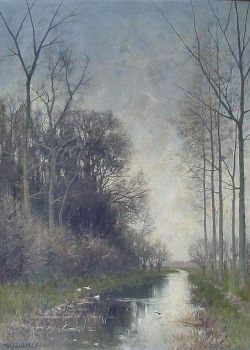
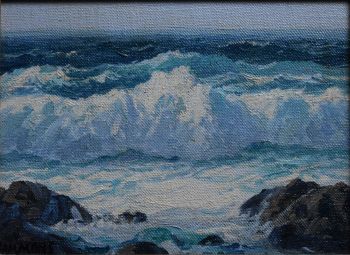
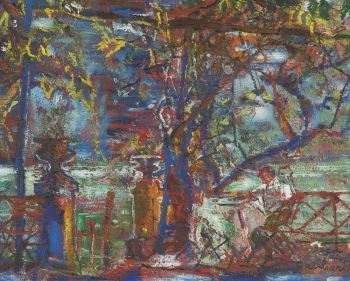
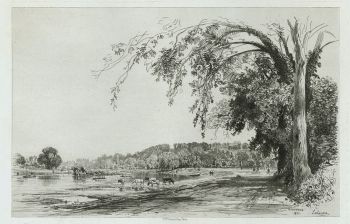
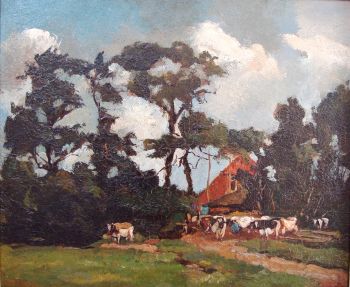
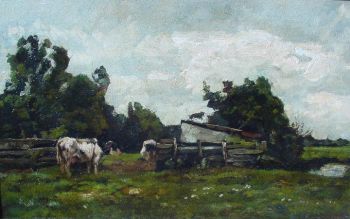
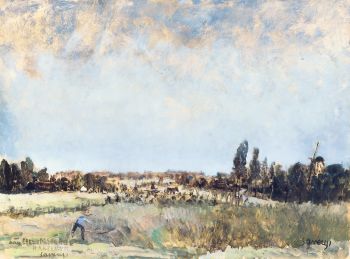
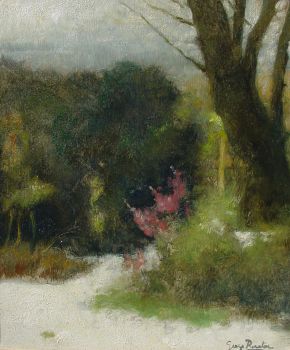
Höhlig's painting style balances between romantic idealization and attention to realistic detail. His landscapes exude peace and balance: meadows in bloom, birch trees along riverbanks, sunlight on fields and snow-covered roofs. His use of colour was nuanced – subdued but never dull – with a special feeling for atmosphere and incidence of light. In addition to landscapes, he also painted still lifes and a few portraits, always with the same craftsmanship and subdued poetry.
Although Höhlig was not an outspoken innovator, he remained true to his vision and was appreciated within regional artist circles. He exhibited his work in Dresden, Leipzig and Chemnitz, and belonged to the artists' association Künstlerbund Dresden. In an era of artistic revolutions, he opted for depth rather than experiment, and found meaning in the familiar and the timeless.
Georg Höhlig died on 4 November 1960 in Erla. His paintings are mainly in private collections and regional museums in Saxony. In the tradition of the silent observer, he left behind an oeuvre that reminds us of the power of the small, the nearby and the familiar landscape — seen through the eyes of an artist who never sought spectacle, but harmony.

























![[copy] #515 150 x 150 cm | gemengde techniek op linnen by Charlot Terhaar sive Droste](https://media-3.gallerease.com/images/d1eb2027-e615-4da4-9789-bf94ce332fed/350x350/copy-515-150-x-150-cm-gemengde-techniek-op-linnen.jpg)