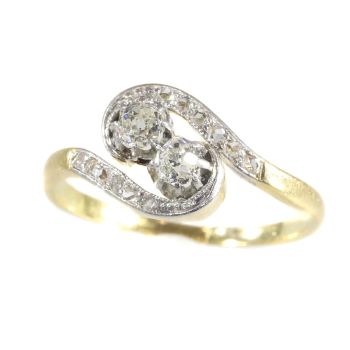
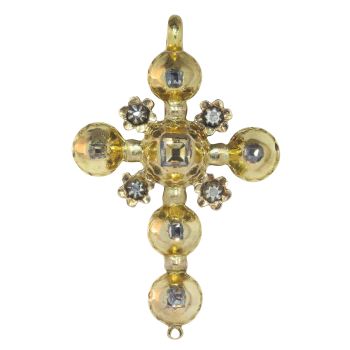
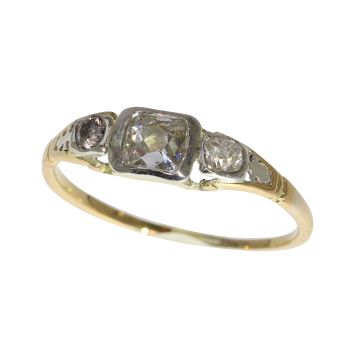
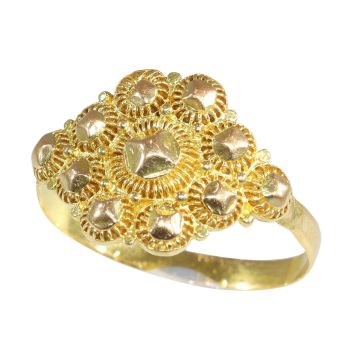
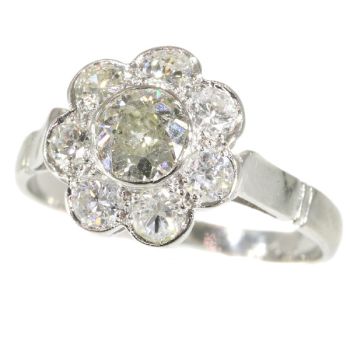
A rare survivor from around 1600, this transitional Renaissance to Baroque cluster ring embodies the discerning taste of early European connoisseurs. Crafted in yellow gold and silver, it holds nine table cut diamonds of exceptional calibre, theirharmonious brilliance a testament to refined selection and mastery. Such uniform quality in stones of this period is extraordinarily rare, marking this jewel as one likely commissioned by a family of distinction. If only jewels could speak, this ringwould recount stories of lineage, prestige, and the dawn of diamond connoisseurship.
This jewel is part of Adin’s curated collection of early European masterpieces, representing over four centuries of jewellery history.
Jewellery Type ring
Condition Very good condition. The ring has been preserved with remarkable care, retaining its structural integrity and original character. The central diamond is secured by a pin running through its centre from the top and fixed with tin along the inner side, atechnique entirely typical for this period. As a result, the stone can turn slightly, which is consistent with its age and method of setting. Minor traces of wear add to its authenticity and charm. more info on our condition scale
Country of origin Unknown. While no conclusive documentation exists, the refined craftsmanship and stylistic characteristics suggest that this jewel could have originated in one of the major European centres of the late Renaissance, such as Italy, the SouthernNetherlands, or possibly Germany. Each of these regions was known for its mastery in early diamond setting and the subtle harmony of gold and silver work.
Style It is uncertain whether this jewel should be classified as Renaissance or Baroque. What is relatively certain, however, is that it was created at the very moment when these two great styles met, a period of artistic transformation when classicalrestraint began to yield to movement and exuberance. Find more info on Baroque and Renaissance. more info on styles
Style specifics Baroque, which emerged shortly before 1600, evolved from the Renaissance tradition and flourished across Europe until the Rococo era around 1730. Originating in Italy and spreading through Germany, Austria, the Low Countries, Spain, and Portugal, itcombined grandeur with vitality. Its sculptural lines, flowing ornament and sense of movement reflect the era’s fascination with light and emotion, in contrast to the balanced symmetry of Renaissance design and the later asymmetry of Rococo.
Period Around 1600 marks the transition from the measured harmony of the Renaissance to the more expressive energy of early Baroque design. This was a time when craftsmanship flourished under the influence of both classical ideals and the emerging taste foropulence that would soon define the seventeenth century. Events & facts of this era, poetry of this era, fashion of this era.
Material 14K yellow gold and silverThis refined combination of metals was typical for precious jewellery of the late Renaissance and early Baroque period. The use of silver around the diamonds enhanced their brightness, while the warmth of gold provided a soft contrast that remainstimelessly beautiful. more info on precious metals
Technique The table cut diamonds are set on foil, a refined technique used to heighten their brilliance and depth. By reflecting light through the carefully faceted stones, this method enhanced their luminosity even in candlelight, revealing the skill of the early diamond cutters and the jewellers who mastered this delicate art.
Extra information The diamonds in this ring display an exceptionally high quality. In all our years in the trade, we have never encountered a jewel of this age set entirely with stones of such uniform and outstanding calibre.
Diamonds Nine table cut diamonds.The exact weight of the stones is unknown, which is customary in our trade for early cuts. Each diamond was carefully selected for its clarity and proportion, and together they create a rare harmony of light. Such uniform quality in stones of this period is seldom encountered and reflects the exceptional taste and means of the original patron.
- All diamonds, regardless of their size or shape, in our vintage and antique jewellery are verified as 100% natural by the IJGC laboratory.
Birthstones Diamond is the birthstone for April and has long been associated with strength, purity, and everlasting love. Its symbolism of constancy made it a cherished choice for jewels of sentiment throughout history, a meaning that still endures today. more info on birthstones
Hallmarks No hallmarks are present, which is not unusual for jewellery of this early period. Hallmarking systems were still developing around 1600 and often applied inconsistently across regions. The absence of marks therefore aligns with its age and craftsmanship rather than detracting from its authenticity. more info on hallmarks
Dimensions The width at the top of the ring measures 1.31 cm (0.52 inch). see picture with a ruler in millimeters and inches
Weight 3,70 gram (2,38 dwt) The lightness of the design is typical for the period and reflects the delicate balance between strength and refinement that characterises early European craftsmanship.
Resizing We offer complimentary resizing for this ring so it may be worn comfortably and securely. Only in cases requiring an exceptional adjustment may a small fee apply. Our goldsmiths take the utmost care to preserve the integrity and historical character ofeach jewel during the resizing process. more info on ring sizes
Adin Reference Nº 25296-0103
Copyright photography Adin, fine antique jewellery
Additional information our latest acquisitions jewelry glossary wall of fame visit us in Antwerp subscribe to our mailinglist
Può succedere che un artista o un creatore sia sconosciuto.
Alcune opere non sono determinate da chi sono state realizzate o sono state realizzate da (un gruppo di) artigiani. Esempi sono statue dell'antichità, mobili, specchi o firme non chiare o leggibili ma anche alcune opere non sono affatto firmate.
Inoltre puoi trovare la seguente descrizione:
•"Attribuito a …." A loro avviso probabilmente opera dell'artista, almeno in parte
•“Studio di ….” o “Officina di” A loro avviso un'opera eseguita nello studio o nella bottega dell'artista, eventualmente sotto la sua supervisione
•“Cerchio di…” A loro avviso un'opera del periodo dell'artista che mostra la sua influenza, strettamente legata all'artista ma non necessariamente al suo allievo
•"Stile di..." o "Seguace di..." A loro avviso un'opera eseguita nello stile dell'artista ma non necessariamente da un allievo; può essere contemporaneo o quasi contemporaneo
•“Modalità di…” A loro avviso un'opera nello stile dell'artista ma di epoca successiva
•"Dopo …." A loro avviso una copia (di qualsiasi data) di un'opera dell'artista
•“Firmato…”, “Datato…” o “Iscritto” A loro avviso l'opera è stata firmata/datata/inscritta dall'artista. L'aggiunta di un punto interrogativo indica un elemento di dubbio
•"Con firma....", "Con data...", "Con iscrizione..." o “Riporta firma/data/iscrizione” a loro avviso la firma/data/iscrizione è stata aggiunta da qualcuno diverso dall'artista
Sei interessato ad acquistare questa opera d'arte?