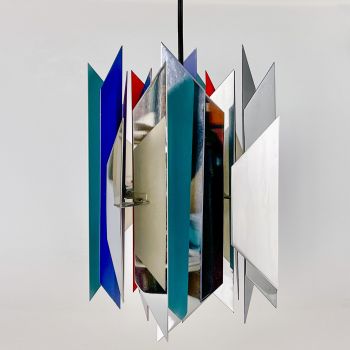
A rare set of four vintage ‘Käsikranaatti’ (Hand Grenade) pendants, model A110. Designed by Alvar Aalto in 1951-1952 and made under license by Louis Poulsen in the 1960’s.
Model A110 is often referred to as the ‘Käsikranaatti’ (Hand Grenade) because it resembles a stick handgrenade and was designed for building constructed for the Finnish Engineers’ Association (Insinööritalo) and also used in the council chamber at Säynätsalo Town Hall.
In 1953, the Finnish company Valaisinpaja Oy (Lighting Workshop Ltd.) was established by Aalto and his circle, and it later became Valaisinpaja Aalto Oy. To bring Allto lighting-designs to a broader international market, production partnerships were established. One of the most significant was with Louis Poulsen of Copenhagen, already well known for Poul Henningsen’s PH lamps. Poulsen’s global distribution network helped Aalto’s lamps reach beyond Finland and Scandinavia. While Louis Poulsen helped bring Aalto’s lights to the international market in the 1950s and 1960s, the production rights eventually shifted and Louis Poulsen license ended late 1960’s.
About Alvar Aalto
Alvar Aalto (1898 Kuortane – Helsinki 1976) was a Finnish architect and designer whose work helped shape modern architecture and design in the 20th century. His career, spanning over five decades, produced a remarkable body of work ranging from buildings and furniture to glassware and urban planning. Aalto’s designs combined modernist ideals with a humanistic approach, earning him an enduring place in architectural history.
Hugo Alvar Henrik Aalto, better known as Alvar Aalto, was born on 3 February 1898 in the small town of Kuortane, Finland. He grew up in Jyväskylä, where his interest in drawing and the natural environment developed early. In 1916 he enrolled at the Helsinki University of Technology, studying architecture and graduating in 1921. Soon after, he opened his first architectural office in Jyväskylä, beginning with small residential and public commissions.
During the 1920s Aalto was influenced by Nordic Classicism, evident in his early works such as the Jyväskylä Workers’ Club (1925). By the end of the decade, he embraced functionalism and modernist principles. One of his first major projects in this style was the Paimio Sanatorium (1929–33), a tuberculosis hospital. The building is considered a landmark of modern architecture, with light-filled spaces, carefully planned patient rooms, and innovative details such as color schemes designed to promote recovery. This project demonstrated Aalto’s belief that architecture should serve human needs both physically and psychologically.
Aalto’s reputation spread internationally during the 1930s and 1940s. His participation in the 1939 New York World’s Fair, where he designed the Finnish Pavilion, brought his work to a wider audience. Around the same time, he expanded into furniture and product design, co-founding the company Artek in 1935 with his wife Aino Aalto and colleagues. The firm produced his bentwood furniture, including the famous Stool 60, which remains in production today. His designs combined technical innovation with simplicity and warmth, using natural materials such as wood in ways that felt modern yet approachable.
Aalto also contributed significantly to glass design. His Savoy Vase (1936), created for a luxury restaurant in Helsinki, became one of the most iconic pieces of Scandinavian design. The vase’s organic, flowing shape reflected his interest in natural forms and stood apart from the strict geometries of other modernist designers.
In architecture, Aalto’s later works moved away from strict functionalism toward a more organic and expressive style. Key projects include the Baker House dormitory at MIT in Cambridge, Massachusetts (1947–49), the Finlandia Hall in Helsinki (1971), and the Säynätsalo Town Hall (1949–52). These works show his sensitivity to site, materials, and the experience of the user.
Beyond his individual buildings, Aalto also worked on urban planning, including projects for Rovaniemi and Seinäjoki in Finland. His planning reflected the same concern for human scale and integration with the landscape that marked his architecture.
Alvar Aalto passed away on 11 May 1976 in Helsinki. By then, he had become one of Finland’s most celebrated cultural figures and a leading voice in international modernism. His work continues to be studied for its blend of innovation, functionality, and humanity, ensuring his legacy as one of the great architects and designers of the 20th century.
Marked
Labels of previous owner (Danish bank)
On the porcelain sockets Louis Poulsen label
Execution
Made in license by Louis Poulsen Copenhagen 1960's
Condition
Good original condition. Wear consistent with age and use, Rewired. Mounted on new ceiling ring.
Dimensions
Each pendant
Height 42 cm
Diameter 15,6 cm