Jean Timmermans
BiographyAbout the artist
Jean Timmermans (Brussels, 1899 – Ixelles, 1986) was a prominent Belgian painter, watercolorist, draftsman, and illustrator. He is best known as an important representative of Animism, a distinctive movement in Belgian painting that emerged shortly after the First World War and sought to restore tranquility, intimacy, and human warmth in reaction to the turmoil and fragmentation of modern society.
Born in Brussels, Timmermans studied at the Académie Royale des Beaux-Arts, where he developed a refined technical foundation and a deep sensitivity to atmosphere and composition. During the interwar period, he became closely associated with the circle of Belgian animist painters, alongside artists such as Constant Permeke, Gustave Van de Woestyne, and Anto Carte. Rather than focusing on avant-garde experimentation, Timmermans emphasized serenity, contemplative stillness, and the spiritual presence of everyday subjects.
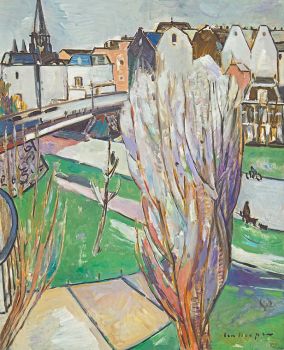
His oeuvre includes portraits, interiors, still lifes, landscapes, and intimate scenes of daily life, often rendered with soft tonal harmonies and careful attention to light. His paintings are characterized by balanced compositions, subtle emotional depth, and a restrained poetic realism that reflects the ideals of the animist movement. Alongside his paintings, Timmermans was also highly regarded for his watercolors, drawings, and illustrations, which displayed the same sensitivity and precision.
Throughout his long career, Timmermans exhibited widely in Belgium and gained recognition for the quiet humanism and timeless atmosphere that permeate his work. Although less internationally known than some of his contemporaries, he occupies an important place within twentieth-century Belgian art for his contribution to the development of animism and figurative painting. Today, his work is appreciated for its elegance, calm introspection, and its enduring reflection of the emotional and spiritual dimensions of ordinary life.
Related artworks for sale



Willem Maris
Polderlandschap met koeien en molens op warme zomerdag1880 - 1890
Price on requestPrivate Collection Classic Arts