Paul Charlemagne
BiographyAbout the artist
Early Life and Education
Paul Charlemagne was born on January 1, 1892, in the 17th arrondissement of Paris, into an artistic family. His father, Hippolyte Charlemagne, was a painter of historical scenes, and his grandfather, Auguste Charlemagne, was a renowned stained glass artist. The young Paul was taught by his father at an early age, but after his father's death in 1906, he became an apprentice to the influential theater decorator Marcel Jambon.
He continued his education at the École supérieure de dessin de Montparnasse and studied under Jacques Jobbé-Duval, Adolphe Barnoin, and Charles Guérin at the Académie de la Grande Chaumière. Here his classical training was infused with a more liberal approach to color and form.
The War and the Interbellum (1920–1935)
During the First World War (1914–1918), Paul Charlemagne served at the front, where he was wounded several times. The horrors of the war and the death of his brother left deep scars on his personality and artistic sensitivity.
After the First World War, Charlemagne returned to artistic life with a heavy heart. The district where Paul Charlemagne lived between 1920 and 1930 was known as the Quartier du Combat, located in the 19th arrondissement of Paris. Within this district was the rue Asselin (now rue Henri-Turot), which was notorious at the time for the presence of prostitution. During this period, he began painting nudes, among other things, often in intimate, almost voyeuristic interiors.
During this period, much earlier than many of his contemporaries, he painted female workers in the sex industry — not as objects, but as powerful women in their social context. This gave his work a social-realist undertone, mixed with a melancholic sensuality.
Salon Career and Artistic Collaborations (1925–1940)
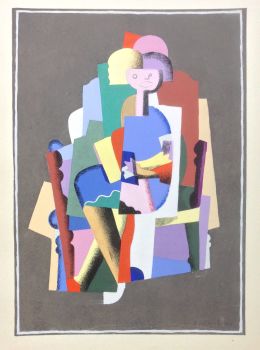
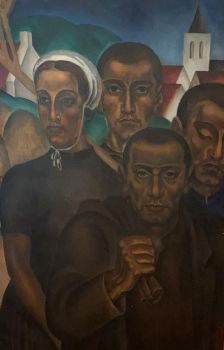
From 1925 onwards, Charlemagne regularly participated in the Salon d'Automne and the Salon des Indépendants, where he won praise for his technical skill and his penetrating portraits of women, musicians and workers. His work was influenced by and compared to that of Raoul Dufy, Othon Friesz and Henry de Waroquier, with whom he collaborated in 1936 on the monumental murals for the Théâtre national de Chaillot.
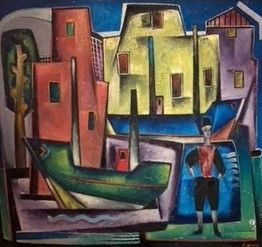
In 1930 he moved to a studio in Montmartre, where he shifted his attention to urban landscapes and interiors, often with a solitary woman as his subject.
Multidisciplinary Master: Ceramics and Education (1934–1962)
In addition to painting, Charlemagne worked as a designer for the Manufacture nationale de Sèvres from 1934 to 1960, where he produced more than 200 ceramic designs. He was appointed professor at the École nationale supérieure des arts décoratifs in 1943, where he taught young artists until 1962.
Recognition and Influence
In 1923, he won the prestigious Prix Blumenthal. He was made an Officer of the French Legion of Honor in 1959 for his services to art. His style was difficult to pigeonhole — he worked figuratively, flirted with cubist forms, but remained true to his personal visual language.
Collections and Exhibitions
Works by Paul Charlemagne are currently held in leading private collections in Paris, Geneva, and New York. Museums such as the Centre Pompidou (Paris) and the Kröller-Müller Museum (Otterlo) own his work, including La violoncelliste (1932) and La Vieille Marcquoise (1938). His paintings remain beloved for their emotional depth, technical refinement and subtle tension between beauty and social observation.
In 2022, the Musée du Mont-de-Piété in Bergues dedicated a major retrospective to him: Paul Charlemagne (1892–1972), l’œuvre révélée — which initiated a revaluation of his oeuvre.
Death and Legacy
Charlemagne died on 10 May 1972 in Paris. Today, his work is seen as a bridge between academic discipline and bohemian freedom, between sensuality and social commitment. His oeuvre reminds us that art not only shows beauty, but also the truth of the time in which it was created.