About the artist
S. Teddy Darmawan, better known as S. Teddy D. (1970–2016), was one of the most elusive and expressive figures in the Indonesian art scene of his generation. Born in Padang, West Sumatra, and educated at the prestigious Institut Seni Indonesia (ISI) in Yogyakarta, where he graduated in painting in 2000, Teddy developed into an artistic force that broke through disciplines and conventions.
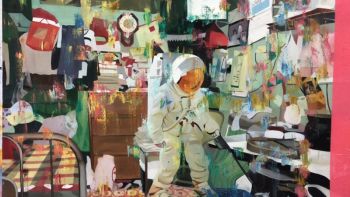
His work was as impetuous as his personality: expressive, playful, ironic, and at the same time imbued with a deep sense of social and personal reality. Paintings, drawings, installations, sculptures and performances — S. Teddy D. knew no boundaries in his quest for expression. His art formed a kind of visual diary: a colorful collage of his family, friends, neighborhood, the dog, military symbolism (born from the fact that his father was a soldier), media fragments and – always – his own self-portrait. But they were not ego documents in the classical sense: they were raw, often absurdist reflections on being human in a rapidly changing world.
What really set S. Teddy D. apart was his ability to make the banal sublime. He built small theaters in which he arranged everyday objects — a shoe, a toy figure, a television screen — into scenes of poetic absurdity. In doing so, he gave a theatrical charge not only to his own life, but also to that of his audience. His works were anarchistic mythologies of ordinary life.
He did not shy away from coloring outside the lines — literally and figuratively. Inspired by the raw aesthetics of graffiti, tattoos, and punk culture, and related to kindred spirits such as Bob Sick Yudhita and EddiE haRA, S. Teddy D. thumbed his nose at the art elite and developed a unique, rebellious visual language that resonated deeply with the rise of the Indonesian contemporary art market in 2008.
S. Teddy D. passed away in 2016, but his work lives on as a scream and a laugh — rebellious, disarming, full of life. He was the poet of the banal, the punk of the brush, the dreamer with mud on his feet. In his mythologies of everyday life, we see ourselves — sometimes laughing, sometimes lost — but always with open eyes.
Artworks
Filter Artworks
2 artworks for sale by S Teddy D(armawan)


Related artworks for sale










Jean-François Rauzier
Real Cabinete - Limited edition of 8 2017
Price on requestVilla del Arte Galleries