About the artist
Ba Nyan is often considered the greatest name in modern Myanmar painting. His work combined Western academic techniques with a subtle Asian sensibility, giving him a unique position in his country’s art history. Characterized by a serene and realistic style, his oil paintings reveal moments of sheer virtuosity upon closer inspection—he mastered the play of light and shadow, the power of impasto brushstrokes, and the rich texture of oil paint in a way few of his contemporaries could match.
Born in 1897 in British Burma, Ba Nyan grew up during a period of great cultural transition. The influence of colonial powers brought Western art traditions to the country, and Ba Nyan was one of the first to absorb and incorporate these techniques into his own work. He received part of his artistic training in Europe, where he mastered the oil painting techniques of the classical masters. He blended these European influences with traditional Burmese themes, creating a bridge between East and West.
His subjects were often simple—landscapes, village scenes, and portraits—but his brushwork had a depth and complexity that went beyond mere academic precision. He transformed the mundane into the timeless, capturing not just the physical reality of his subjects but also their souls.
Despite his relatively short life—he died in 1945 at the age of just 48—Ba Nyan had a lasting impact on the Burmese art world. He inspired generations of artists to combine traditional and Western styles, and his work is still revered as one of the first true expressions of modern painting in Myanmar. His legacy lives on in museums, private collections, and the hearts of art lovers who continue to appreciate his masterful control of color, texture, and composition.
Related artworks for sale





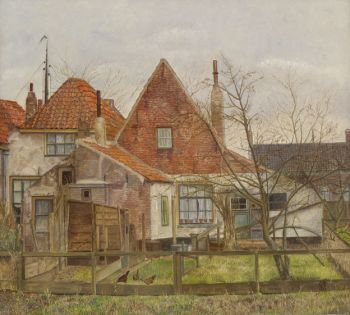
Tjitske Geertruida Maria van Hettinga Tromp
ACHTER HET HUIS1872 - 1962
Price on requestGalerie Het Noorderlicht