About the artist
Walter Furlan (1931–2018) was an Italian master glass artist who played a pivotal role in redefining the expressive possibilities of Murano glass in the postwar period. Born in Chioggia and later active on the island of Murano, he became widely respected for bridging the worlds of fine art and traditional glassmaking.
Furlan distinguished himself through a rare ability to translate two-dimensional imagery into sculptural form. Working at the intersection of craftsmanship and interpretation, he developed complex techniques that allowed him to reimagine painted compositions as three-dimensional glass objects—retaining their essence while adding depth, movement, and material presence. His work required not only technical mastery, but also a deep sensitivity to composition, color, and artistic intent.
He is best known for his authorized glass interpretations of works by Pablo Picasso. Rather than producing literal reproductions, Furlan approached these pieces as reinterpretations, carefully adapting Picasso’s visual language into the fluid, luminous medium of glass. The result was a body of work that expanded both the legacy of modern painting and the boundaries of Murano glassmaking.
Throughout his career, Furlan remained closely tied to the Murano tradition, yet he continuously pushed it forward—elevating glass from decorative craft to a fully autonomous artistic medium. His sculptures stand as a testament to the dialogue between disciplines, where technical virtuosity meets artistic imagination.
Today, Walter Furlan is remembered as one of Murano’s most innovative figures: a master who not only preserved a centuries-old tradition, but also transformed it into a contemporary language capable of engaging with the great artists of the modern era.
Related artworks for sale


Unknown artist
François-Théodore Legras – Tall “Fleurs de Pommier” apple blossoms vase1900 - 1909
Price on requestAntiques Emporium

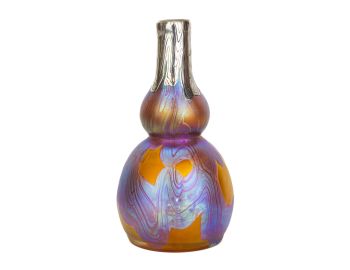
Johann Loetz (Lötz) Witwe Klostermühle
Johann Loetz Witwe - Phänomen Genre 7773 – Orange1900 - 1910
Price on requestAntiques Emporium