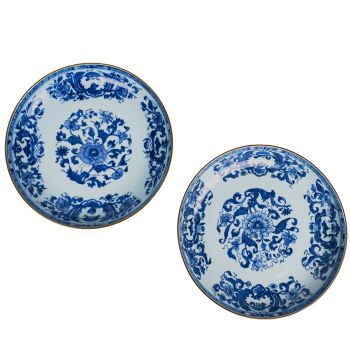
A pair of inscribed blue and white ‘Wild Goose Pagoda’ dishes for the Japanese market, Ko-Sometsuke, 1621 - 1672
Unknown artist
PorcelainChinese porcelain
ø 21 cm
ConditionGood
Price on request
Menken Works of Art
- About the artworkA pair of inscribed blue and white ‘Wild Goose Pagoda’ dishes for the Japanese market, Ko-Sometsuke.
Ming dynasty, Tianqi Period (1621–1627).
The central scene depicts three geese standing in the foreground, with a fourth goose flying above them. Next to this scene appears a four-character inscription that can be translated as: “May your name be inscribed on the wall of the Wild Goose Pagoda in Chang’an.” In the distance, a promontory is shown with a pagoda and a nearby building.
Below this scene, painted upside down, is another four-line verse. This composition gives the impression of a reflection of the pagoda above. The text can loosely be translated as: “May you enjoy the Imperial Spring Banquet in the Apricot Grove.” Beside the inscription is a flowering apricot plant, with three swallows flying above it. The indented cavetto is decorated with a scrolling lotus motif set against a blue ground, while the outer border features a Greek key pattern on a pale blue background.
The first inscription, “May Your Name Be Inscribed on the Wall of the Wild Goose Pagoda in Chang’an,” refers to a tradition that began during the Tang dynasty (618–907). Candidates who successfully passed the highest level of the Jinshi civil service examinations were honored by having their names recorded on the wall of the Wild Goose Pagoda in Chang’an, the capital of the Tang empire.
The second inscription, “May You Enjoy the Imperial Spring Banquet in the Apricot Grove,” alludes to a celebratory banquet traditionally held near the Wild Goose Pagoda for those who had achieved success in the examinations. This message is further emphasized through a visual rebus that combines images of spring swallows with blooming apricot branches, both symbols associated with spring and scholarly achievement.
Diameter 21 cm.
Provenance:
Fa. A.C. Beeling & Zn., Leeuwarden, The Netherlands (sticker on one of the dishes)
Leegstra collection, Warffum, The Netherlands (sticker on both dishes)
Ref:
A similar dish is illustrated in Leaping the Dragon Gate: The Sir Michael Butler Collection of 17th-Century Chinese Porcelain (Katharine Butler, Teresa Canepa, 2021
Also see Four Centuries of Blue and White – The Frelinghuysen Collection of Chinese and Japanese Export Porcelain (Becky Macguire, 2023), p. 304, no. 248.
Another dish is in the Groninger Museum collection, object number 2018.0013.
Worldwide registered and insured shipping.
Inv. No: MW381 - About the artist
It might happen that an artist or maker is unknown.
Some works are not to be determined by whom it is made or it is made by (a group of) craftsmen. Examples are statues from the Ancient Time, furniture, mirroirs, or signatures that are not clear or readible but as well some works are not signed at all.
As well you can find the following description:
•“Attributed to ….” In their opinion probably a work by the artist, at least in part
•“Studio of ….” or “Workshop of” In their opinion a work executed in the studio or workshop of the artist, possibly under his supervision
•“Circle of ….” In their opinion a work of the period of the artist showing his influence, closely associated with the artist but not necessarily his pupil
•“Style of ….” or “Follower of ….” In their opinion a work executed in the artist’s style but not necessarily by a pupil; may be contemporary or nearly contemporary
•“Manner of ….” In their opinion a work in the style of the artist but of a later date
•“After ….” In their opinion a copy (of any date) of a work of the artist
•“Signed…”, “Dated….” or “Inscribed” In their opinion the work has been signed/dated/inscribed by the artist. The addition of a question mark indicates an element of doubt
•"With signature ….”, “With date ….”, “With inscription….” or “Bears signature/date/inscription” in their opinion the signature/ date/ inscription has been added by someone other than the artist
Are you interested in buying this artwork?
Artwork details
Related artworks
Unknown artist
A pair of Dutch Colonial Solid Satinwood Chairs, Ceylon 18th century1725 - 1750
Price on requestMenken Works of Art
1 - 4 / 12Unknown artist
A rare Chinese blue and white bottle vase, Ming dynasty, Wanli period1573 - 1620
Price on requestMenken Works of Art
1 - 4 / 6Unknown artist
A Chinese powder-blue-ground blue and white ‘Budai’ dish, Kangxi period1662 - 1722
Price on requestMenken Works of Art
Unknown artist
A rare Chinese blue and white bottle vase, Ming dynasty, Wanli period1573 - 1620
Price on requestMenken Works of Art
Unknown artist
A Chinese famille verte ‘fishermen’ bowl, Kangxi period (1662-1722)1662 - 1722
Price on requestMenken Works of Art
Unknown artist
Set Arita 'dog training' plates, 18th century 1700 - 1730
Price on requestVerkoulen Oriental & European Antiques
1 - 4 / 24Unknown artist
A Chinese famille verte ‘fishermen’ bowl, Kangxi period (1662-1722)1662 - 1722
Price on requestMenken Works of Art
Unknown artist
A Chinese powder-blue-ground blue and white ‘Budai’ dish, Kangxi period1662 - 1722
Price on requestMenken Works of Art
Unknown artist
A rare Chinese blue and white bottle vase, Ming dynasty, Wanli period1573 - 1620
Price on requestMenken Works of Art
1 - 4 / 24Unknown artist
A rare Chinese blue and white bottle vase, Ming dynasty, Wanli period1573 - 1620
Price on requestMenken Works of Art
Unknown artist
A pair of Dutch Colonial Solid Satinwood Chairs, Ceylon 18th century1725 - 1750
Price on requestMenken Works of Art
1 - 4 / 12