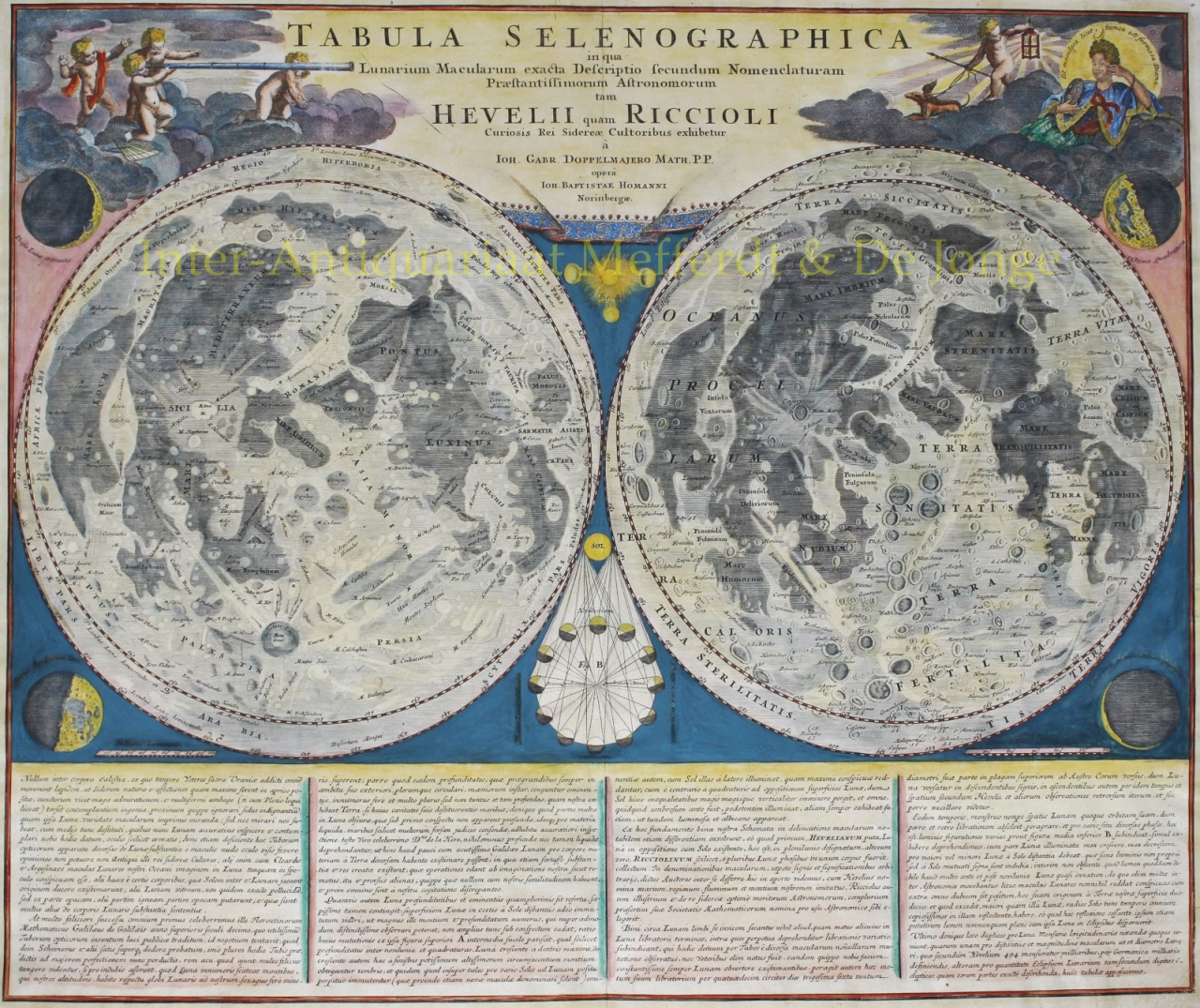
Map of the moon  by Johann Baptist Homann
Scroll to zoom, click for slideshow

Map of the Moon 1742 - 1748

Johann Baptist Homann

€ 1.950

Inter-Antiquariaat Mefferdt & De Jonge

  • Over kunstwerk
    IMPORTANT MAP OF THE MOON “Tabula Selenographica in qua Lunarium Macularum exacta Descriptio secundum Nomenclaturam … Hevelii quam Riccioli”. Copper engraving made by Johann Baptist Homann after Johann Gabriel Doppelmayr, from the Atlas Coelestis in quo Mundus Spectabilis published in Nuremberg in 1742 or 1748. Coloured by a later hand. Size c. 48,5 x 58 cm. The left hand lunar map, composed by Johannes Hevelius, is a considered a foundational map in the science of Selenography – or lunar cartography. This map first appeared in Hevelius’ 1647 work Selenographia which laid the groundwork for most subsequent lunar cartographic studies. Here the moon is presented as it can never be seen from Earth, at a greater than 360 degrees and with all visible features given equal weight. In this map Hevelius also establishes the convention of mapping the lunar surface as if illuminated from a single source – in this case morning light. The naming conventions he set forth, which associate lunar features with terrestrial locations such as “Asia Minor”, “Persia”, “Sicilia”, etc. were popular until the middle of the 18th century when Giovanni Battista Riccioli’s nomenclature took precedence. The Riccioli map, on the right, is more properly known as the Riccioli-Grimaldi map, after fellow Jesuit Francesco Grimaldi with whom Riccioli composed the chart. This map first appeared in Riccioli and Grimaldi’s 1651 Almagestum Novum. This was a significant lunar chart and offered an entirely new nomenclature which, for the most part, is still in use today. Curiously, though Riccioli, as a devout Jesuit, composed several treatises denouncing Copernican theory, he chose to name one of the Moon’s most notable features after the astronomer – perhaps suggesting that he was a secret Copernicus sympathizer? Other well-known lunar features named by Riccioli include the Sea of Tranquility where Apollo 11 landed and where Neil Armstrong became the first human to set foot on the moon’s surface 50 years ago. The upper left and right hand quadrants feature decorative allegorical cartouche work that include images of putti looking through a telescope and a representation of the ancient Greek Moon goddess Selene. Additional smaller maps show the moon in various phases of its monthly cycle. Below the map proper extensive Latin text discusses Selenography. This map first appeared Johann Baptist Homann’s 1707 Neuer Atlas and was later reissued as plate no. 11 in Doppelmayr’s important 1742 Atlas Coelestis, which was also published by Homann. Price: 1.950,-
  • Over kunstenaar

    Johann Baptist Homann (1664-1724) was een vooraanstaande Duitse cartograaf, graveur en uitgever uit het begin van de 18e eeuw, algemeen beschouwd als een van de meest invloedrijke cartografen van zijn tijd. Geboren in Oberkammlach in Beieren, volgde hij aanvankelijk onderwijs aan een jezuïetenschool voordat hij zich bekeerde tot het protestantisme – een beslissing die zowel zijn persoonlijke als professionele levenspad zou bepalen.Johann Baptist Homann (1664-1724) was een vooraanstaande Duitse cartograaf, graveur en uitgever uit het begin van de 18e eeuw, algemeen beschouwd als een van de meest invloedrijke cartografen van zijn tijd. Geboren in Oberkammlach in Beieren, volgde hij aanvankelijk onderwijs aan een jezuïetenschool voordat hij zich bekeerde tot het protestantisme – een beslissing die zowel zijn persoonlijke als professionele levenspad zou bepalen.

    Homann begon zijn carrière als notaris in Neurenberg in 1687, maar verlegde al snel zijn focus naar graveren en cartografie, gedreven door een groeiende interesse in geografie en de visuele weergave van kennis. Na een vormende periode in Wenen tussen 1693 en 1695 keerde hij terug naar Neurenberg, waar hij in 1702 zijn eigen uitgeverij oprichtte. Dit markeerde het begin van een zeer productieve en invloedrijke carrière.
    Zijn kaarten werden al snel geroemd om hun precisie, helderheid en decoratieve rijkdom, waarbij wetenschappelijke nauwkeurigheid werd gecombineerd met uitgebreide barokke ornamenten. De reputatie van Homann leidde ertoe dat hij in 1715 door keizer Karel VI werd benoemd tot keizerlijk geograaf. Later werd hij verkozen tot lid van de Pruisische Academie van Wetenschappen in Berlijn – een erkenning voor zijn bijdrage aan de vooruitgang van de geografische kennis.

    In 1716 publiceerde Homann zijn beroemdste werk, de Grosser Atlas über die ganze Welt (Grote Atlas van de hele wereld), een omvangrijke en ambitieuze verzameling kaarten die zijn nalatenschap bevestigde. Veel van deze werken werden gemaakt in samenwerking met graveur Christoph Weigel de Oudere. Door zijn uitgeverij en cartografische productie speelde Homann een centrale rol in de vestiging van Neurenberg als belangrijk centrum voor kaartproductie in Europa.

Bent u geïnteresseerd om dit kunstwerk te kopen?

Artwork details