About the artist
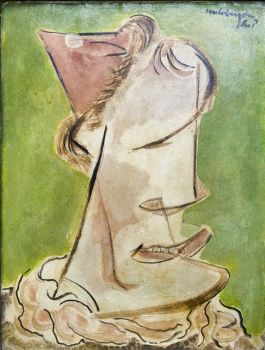
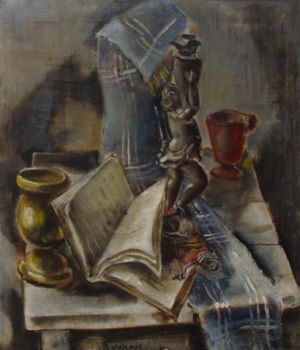
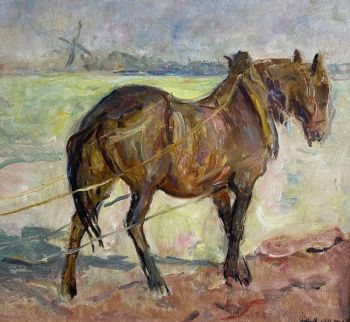
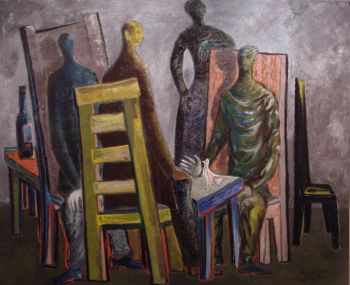
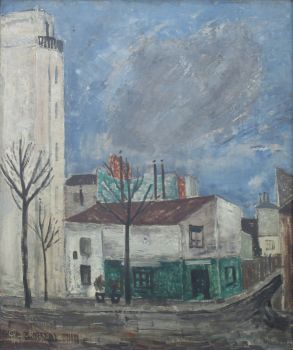
Jan Wiegers (1893-1959) was a prominent Dutch expressionist painter and one of the founders of the Groningen artists' association De Ploeg. Born on 31 July 1893 in Kommerzijl, he began the three-year introductory course at the Academie Minerva in Groningen at the age of 13. Due to health problems, he had to discontinue his sculpture lessons and focused on painting.
After his training, Wiegers moved to Germany in 1911 to broaden his artistic horizons. In 1912, he visited the Sonderbund Exhibition in Cologne, an influential international exhibition of early modern art. When the First World War broke out, he returned to the Netherlands and continued his studies at the Academie Minerva. He also took lessons at the academies in Rotterdam and The Hague.
In 1918, Wiegers was one of the founders of De Ploeg, an artists' collective that strove for innovation in art. His work from this period is characterized by experiments with simplified forms and the use of large areas of color. Critics described him at the time as 'the most modern painter in Groningen'.
A turning point in his career occurred between 1920 and 1922, when he went to Davos, Switzerland, to recover from tuberculosis. There he met the German expressionist Ernst Ludwig Kirchner, with whom he developed a close friendship. Kirchner regarded Wiegers as an equal colleague, and their mutual influence was clearly visible in their work. Wiegers' palette became more lively and his brushstrokes freer and more powerful.
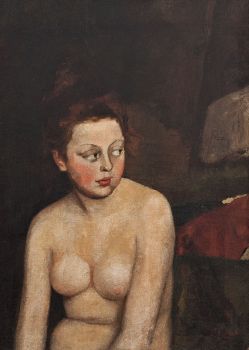
After his return to Groningen, Wiegers introduced the expressionist style within De Ploeg, which led to a collective artistic development within the group. His oeuvre from this period is diverse and includes Swiss landscapes, Groningen scenes, nudes, still lifes, interiors and portraits. In addition to painting, he was involved in etchings and woodcuts, and inspired his colleagues to explore these techniques.
In 1934 Wiegers moved to Amsterdam, where he became a valued portrait painter. However, he remained involved with De Ploeg and participated in their exhibitions until 1948. In 1953 he was appointed professor at the Rijksakademie van Beeldende Kunsten in Amsterdam.
Jan Wiegers died on 30 November 1959 in Amsterdam. His legacy lives on in his expressive and colourful works, which have had a lasting influence on Dutch art history.
Related artworks for sale




Jan Sluijters
Overtoomse sluis te Amsterdam met sneeuw (voor 1925)1910 - 1925
Price on requestBruning Heintz Fine Art