Noriko Ito
BiographyAbout the artist
Noriko Ito (b. 1976, Japan) is a contemporary Japanese artist whose work navigates the vibrant intersection of traditional aesthetics and modern visual culture. Rooted in Tokyo’s dynamic manga scene, Ito has emerged as a distinctive voice within the Superflat movement, a postmodern theory and aesthetic developed by Takashi Murakami. Her work has garnered international attention, finding homes in private collections across the United States, the Netherlands, and Germany.
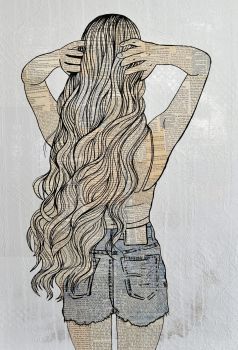
Ito’s artistic language is deeply informed by the visual traditions of manga and anime, drawing on the 2-dimensional, highly stylized forms that characterize these media. However, her contribution goes beyond stylistic homage: she interrogates the very structure of Japanese visual identity. Her canvases present highly saturated color planes, flattened perspective, and pop-infused iconography—deliberately collapsing the boundaries between fine art and mass culture.
In alignment with the Superflat philosophy, Noriko Ito blurs distinctions between "high" and "low" art, using techniques and narratives familiar from consumer culture to deliver nuanced, often unsettling commentary on identity, gender, and societal pressure. Her female figures, often rendered with exaggerated features and dreamlike expressions, reflect both the whimsical and the grotesque aspects of contemporary femininity in Japan. They exist in suspended spaces—neither fantasy nor reality—inviting viewers to confront the contradictions of modern existence.
Educated in Tokyo and immersed in its subcultural underground, Ito has exhibited successfully in major galleries in Japan and has steadily built an international reputation. Her solo exhibitions are known for their immersive quality, sometimes incorporating sound, textile, or animation, bridging the gap between still and moving image.
Though still underrepresented in global discourse compared to her male contemporaries, Noriko Ito’s work continues to gain traction as a vital component of 21st-century Japanese art. She represents a generation that reclaims and redefines cultural icons, channeling them into a visual dialogue that is both deeply local and unmistakably global.