Lucien Frits Ohl was born on 14 August 1904 in Garoet, on the Indonesian island of Java, then part of the Dutch East Indies. This birthplace left a deep and lasting mark on his artistry. His paintings exude the atmosphere of the East: warm, lush and suggestive. Although he would eventually die in The Hague in 1976, his work lives on as a visual bridge between the European craft of painting and the tropical imagination of a lost colonial era.
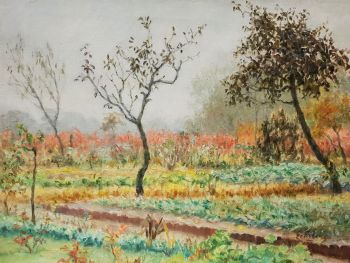
Ohl studied art at the Academy of Fine Arts in The Hague. There he learned the classical technique and composition theory, but he soon developed a more impressionistic touch. The early influence of his youth in the tropics is visible in his use of colour: saturated greens, soft ochre tones and the play of light and shadow that evokes sultry skies and moist earth. He stood in the tradition of artists such as Isaac Israëls and Jan Toorop, who also sought a bridge between European styles and Southeast Asian influences.
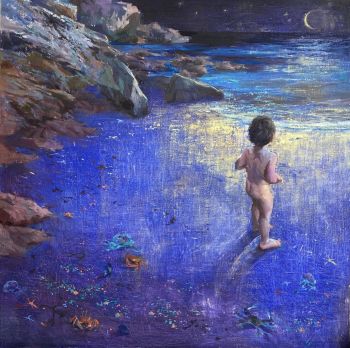
In the 1930s, Ohl returned to the Dutch East Indies. There he found his true subject: life in the tropics. He painted markets, women in sarongs, gamelan players, Balinese dancers, rice fields and coastal views. His style is figurative with an impressionistic touch. The brushwork is loose, the colours warm and dreamy. His work does not evoke an explicit judgement about the colonial context, but rather exudes a melancholic admiration for the everyday and the ritual.
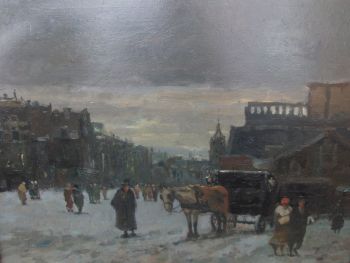
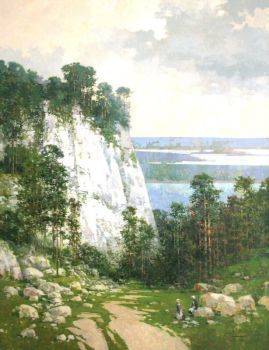
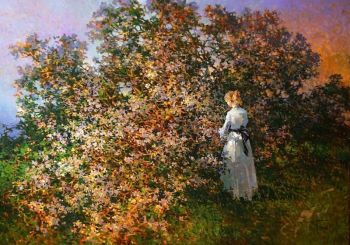
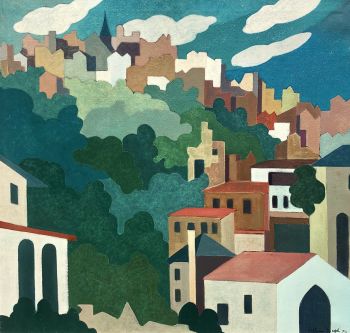
After the Second World War and Indonesian independence, Ohl settled permanently in the Netherlands. He went to live and work in The Hague and became a member of Pulchri Studio, where he exhibited regularly. Although his subjects partly shifted to more Dutch scenes – cityscapes, flowers and landscapes – his palette remained tropical. Even a Dutch street scene was given a soft glow by Ohl, as if the humid heat of Java still hung between the brushstrokes.
His oeuvre consists of paintings in oil paint, often on canvas or board, sometimes also watercolours. He signed with “L.F. Ohl” or with his full name. His work remained popular, especially among collectors of Indian art. His paintings are still valued at auctions, especially for the atmospheric depiction of a vanished world and his skill in capturing light and emotion in subtle shades of colour.
Lucien Frits Ohl was a painter between worlds. He did not make a political work of art, but a poetic visual archive. His paintings are not a report, but memories in colour. They carry a melancholy within them that still appeals: the longing for something that is past, but preserved in paint.