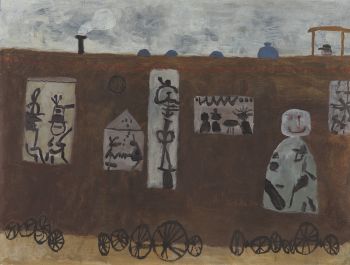
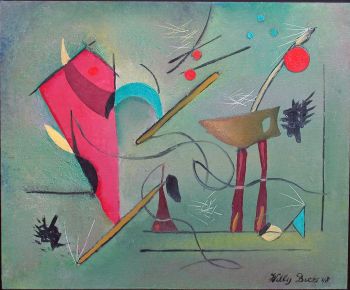
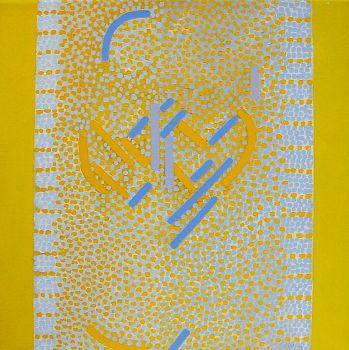
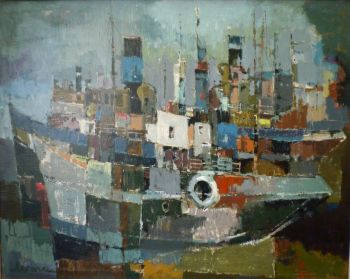
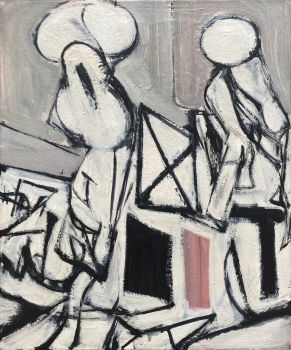
Gust Romijn—full name Gustavus Adrianus Maria Romijn (Noordwijkerhout, October 3, 1922 – Dreischor, January 28, 2010)—was a Dutch sculptor, printmaker, and painter who holds a prominent place in post-war modern art in the Netherlands. His oeuvre is characterized by a strong constructive approach, an architectural sense of form, and a constant interplay between figuration and abstraction.
Romijn initially trained as an architect, a background that continued to influence his visual work. In 1943, he began dedicating himself to painting and sculpture. In the 1950s, he was a member of the Venstergroep (Windows Group), along with artists including Louis van Roode and Piet Roovers, a group of young Rotterdam printmakers who sought innovation in form, composition, and technique. During this period, Romijn participated in E55, for which he created a monumental mural measuring six by two meters, and joined the Liga Nieuw Beelden (New Images League), which emphasized abstraction, construction, and modernist ideals.
His work also gained international recognition. In 1958, Romijn participated in the World Exhibition in Brussels, an important platform for modern art and architecture in Europe. In the 1960s, he briefly lived in New York, where he was exposed to international developments in the visual arts, which further deepened and broadened his work.
After returning to the Netherlands, Romijn combined his artistic practice with teaching at the Rotterdam Academy and the Vrije Academie in The Hague. He lived and worked in Rotterdam for a long time, until settling in Dreischor in 1982, where he continued to work until his death.
Romijn received several awards, including the National 5 May Graphics Prize in 1955 and the Prix Suisse in 1957. His work forms a consistent and idiosyncratic whole within Dutch art of the twentieth century, in which craftsmanship, experimentation and an architectural visual language come together.