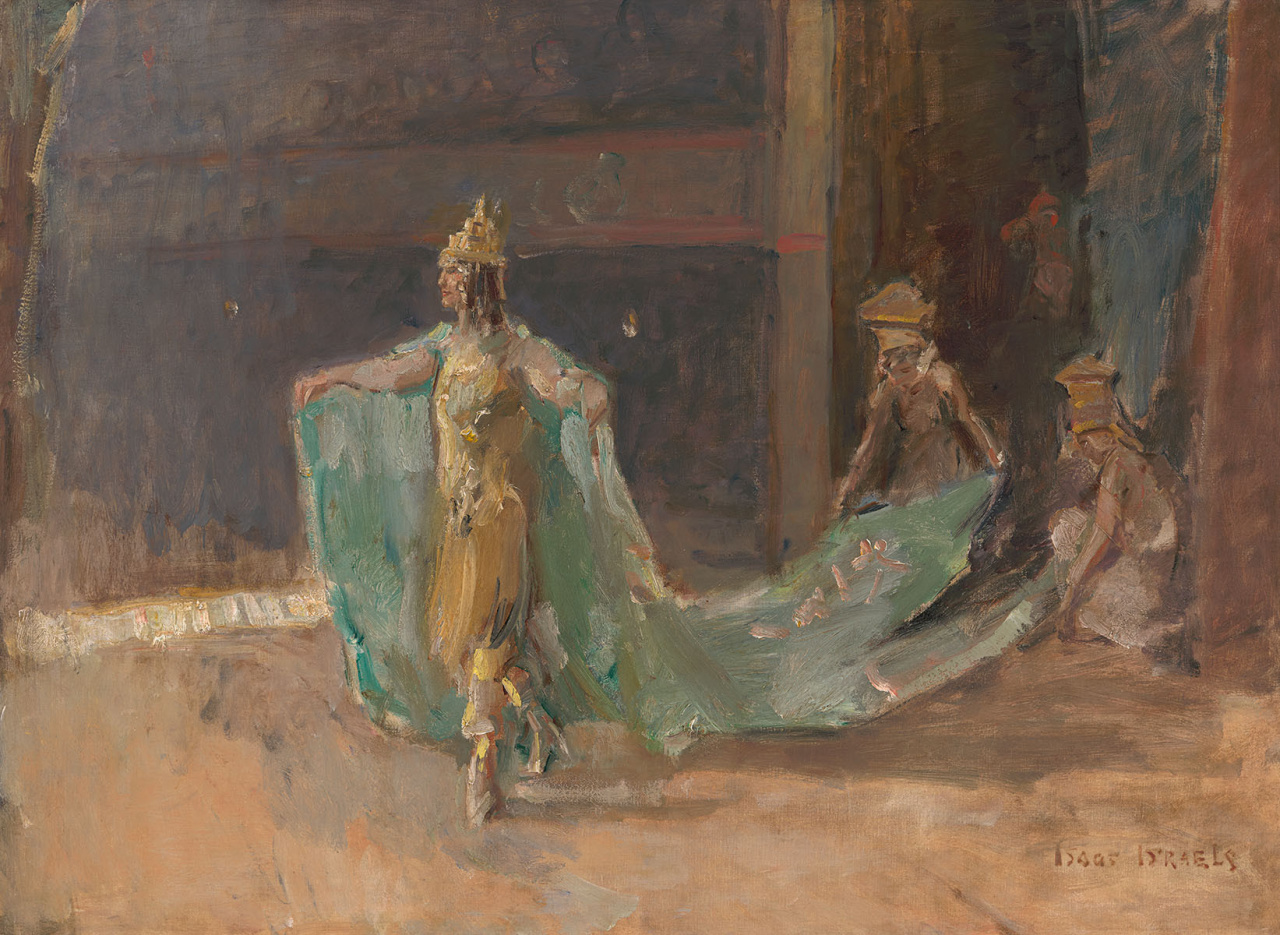
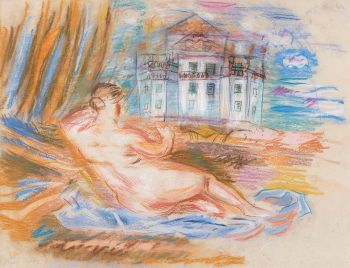
ISAAC ISRAELS Amsterdam 1865-1934 Den Haag DANSERES IN HET SCALA THEATER, DEN HAAG Ca. 1920 Olieverf op doek 90 x 123 cm. Gesigneerd: rechts onder ‘Isaac Israels’ Herkomst: Collectie M.L. Maas, Rotterdam; Collection P. Brandt 1970, nr. 326 De actrice op het podium draagt een gele jurk en een kroon op haar hoofd. Twee bedienden dragen haar lange groene sluier. Aan de rechterzijde zijn de theaterliefhebbers zichtbaar. Vanaf 1915 was Israels veel te vinden in het Scala Theater aan de Wagenstraat in Den Haag waar hij toestemming kreeg om achter de coulissen te tekenen en te schetsen. Israels werkte hier net als in Parijs onverstoorbaar door een vriend vertelde hierover ‘Het gekke was dat Isaac Israels totaal geen begrip had voor de kwaliteit of de inhoud van de voostelling. Als de hele zaalplat lag van plezier, bleef hij onverstoord doortekenen. Wat hem interesseerde was de mens die er stond en zijn picturale mogelijkheden meer dan wat die mens aan het doen was.’
Isaac Israëls (1865-1934) was a prominent Dutch painter, draftsman and watercolourist, known for his lively and dynamic depiction of modern city life. As the son of the renowned Hague School painter Jozef Israëls, he grew up in an artistic environment that stimulated his early interest in art.
Israëls showed remarkable artistic talent at an early age. Between 1880 and 1882 he studied at the Royal Academy of Art in The Hague, where he befriended George Hendrik Breitner, with whom he would later lead the Amsterdam Impressionist movement. His early works, such as "Militaire Begrafenis" and "Transport der Kolonialen", show an academic precision and were recognised at the Salon des Artistes Français in Paris.
In 1886 Israëls settled in Amsterdam and joined the Tachtigers, a group of progressive writers and artists who advocated an intense and emotionally charged technique. Inspired by this philosophy, he focused on capturing the vibrant city life, with scenes from streets, cafés and cabarets. His style is characterized by loose, spontaneous brushstrokes and a bright palette, which gives his paintings a dynamic and lively character. In contrast to contemporaries such as Breitner, who often used dark earth tones, Israëls opted for lighter and fresher colors.
His subjects ranged from cityscapes and café scenes to fashion houses and beach scenes. He had a keen eye for composition and often cut his scenes in such a way that the action seemed to continue outside the frame, which contributed to the feeling of a snapshot. His work shows a strong influence of Impressionism, with a focus on capturing fleeting moments and the effects of light and color.
During his stay in Paris, Israëls was inspired by artists such as Edgar Degas and Henri de Toulouse-Lautrec. These influences are visible in his depictions of Parisian nightlife and the fashion world, where he managed to capture the elegance and energy of the city. He worked with fashion houses such as Paquin and gained access to fashion shows, fitting rooms and ateliers, allowing him to capture the world of haute couture, from seamstresses to wealthy clients.
Israëls' ability to paint the everyday in a vivid and authentic way has earned him a prominent place in Dutch art history. His works offer valuable insight into life in the late 19th and early 20th centuries, seen through the eyes of a master Impressionist. His technique, not without French influence, led to the enduring fame of the Amsterdam Impressionists.
The auction record for the painter was paid for "A table au Restaurant Le Perroquet, Paris", which Christie's hammered down in October 2006 for 493,600 euros.
In 2012, five museums in The Hague dedicated exhibitions to Israëls under the title "Isaac Israëls in The Hague", namely the Hague Historical Museum, Panorama Mesdag, the Louis Couperus Museum, Muzee Scheveningen and the Hague Municipal Archives. The exhibition "Isaac Israëls in Amsterdam" was on display in the Amsterdam City Archives from 15 June to 9 September 2012.
Isaac Israëls died on 7 October 1934 in The Hague, two days after being hit by a car. His work remains valued and can be found in collections of, among others, the Rijksmuseum Amsterdam and Museum de Fundatie in Zwolle.