Powered byPowered by Gallerease
North America - Pierre Mariette + Guillaume Sanson by Unknown artist
Scroll to zoom, click for slideshow

North America - Pierre Mariette + Guillaume Sanson 1669

Unknown artist

Paper
40 ⨯ 55 cm
€ 2.750

Inter-Antiquariaat Mefferdt & De Jonge

  • About the artwork
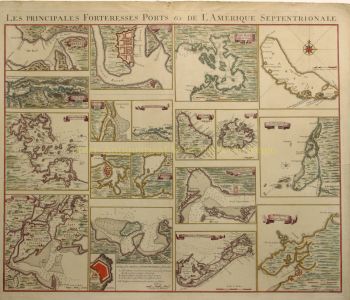
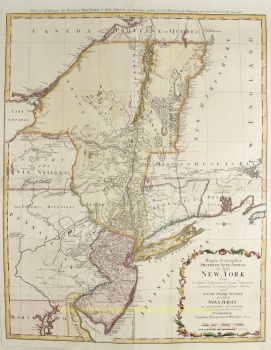
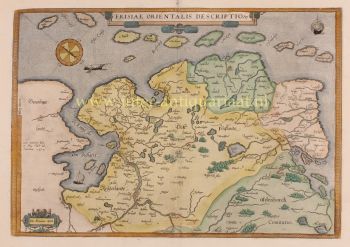
    Amerique Septentrionale Copper engraving made by Pierre Mariette and published by Guillaume Sanson in 1669 after the death of Guillaume's father, Nicolas, in 1667. Coloured by a later hand. Size: 40 x 55 cm. It is a reduced-size copy of Nicolas Sanson's four-sheet wall map of North America, published in 1666, which survives in only two known examples (one dated 1666, one dated 1667). However, this map has changed as compared to its wall-map predecessor. It includes C. Blanco in California and adds R. de Nort, or the Hudson River. The shape of Iceland and the British Isles are also new. The continent is tightly framed, with only a small part of northern South America visible. California is shown as an island, in the form originating from British explorer Luke Foxe's map published in 1635. The northwest of the continent is empty and obscured by the decorative cartouche. In the northeast, Greenland appears connected to North America. New North Wales seemingly floats in northern Hudson’s Bay, giving way to another coastline, New Denmark. This trails southwest-ward to a Mer Glaciale—the dream of a Northwest Passage is alive and well on this map. Much of this configuration is inspired by Thomas Button’s trip to Hudson’s Bay in 1612-3, when he named Port Nelson and Ne Ultra. Button’s Bay is named for him. Luke Foxe, on another voyage seeking the passage in 1631, named the area New Wales. The center of the continent is dominated by Quivira. This toponym refers to the Seven Cities of Gold sought by the Spanish explorer Francisco Vasquez de Coronado in 1541. In 1539, Coronado wandered over what today is Arizona and New Mexico, eventually heading to what is now Kansas to find the supposedly rich city of Quivira. Although he never found the cities or the gold, the name stuck on maps of southwest North America, wandering from east to west. Literature: Philip Burden, The Mapping of North America (1996), nr. 404. Price: Euro 2.750,-
  • About the artist

    It might happen that an artist or maker is unknown.

    Some works are not to be determined by whom it is made or it is made by (a group of) craftsmen. Examples are statues from the Ancient Time, furniture, mirroirs, or signatures that are not clear or readible but as well some works are not signed at all.

    As well you can find the following description:

    •“Attributed to ….” In their opinion probably a work by the artist, at least in part

    •“Studio of ….” or “Workshop of” In their opinion a work executed in the studio or workshop of the artist, possibly under his supervision

    •“Circle of ….” In their opinion a work of the period of the artist showing his influence, closely associated with the artist but not necessarily his pupil

    •“Style of ….” or “Follower of ….” In their opinion a work executed in the artist’s style but not necessarily by a pupil; may be contemporary or nearly contemporary

    •“Manner of ….” In their opinion a work in the style of the artist but of a later date

    •“After ….” In their opinion a copy (of any date) of a work of the artist

    •“Signed…”, “Dated….” or “Inscribed” In their opinion the work has been signed/dated/inscribed by the artist. The addition of a question mark indicates an element of doubt

    •"With signature ….”, “With date ….”, “With inscription….” or “Bears signature/date/inscription” in their opinion the signature/ date/ inscription has been added by someone other than the artist

Are you interested in buying this artwork?

Artwork details