Wilhelm Kaufmann (25 May 1895 – 14 February 1975) was an Austrian painter whose life and work were deeply interwoven with the cultural upheavals of 20th-century Europe. A gifted talent from an early age, he became, at just sixteen, the youngest student ever admitted to the Academy of Fine Arts in Vienna, where he studied under the influential painter Rudolf Bacher.
His early artistic promise was interrupted by the First World War. Kaufmann served three years on the Russian-Albanian front and was awarded the Austro-Hungarian Golden Cross of Merit for bravery. After the war, he returned to Vienna determined to pursue life as a freelance artist, immersing himself in the city’s vibrant avant-garde circles. He exhibited with the progressive Vienna Secession and joined the modernist collective Sonderbund Österreichischer Künstler. In 1927, he became a member of the Hagenbund, another leading association of forward-thinking artists.
The annexation of Austria by Nazi Germany in 1938 brought this flourishing cultural life to an abrupt halt. Both the Secession and the Hagenbund were dissolved, and Kaufmann faced a professional ban under the regime. Forced to abandon painting, he worked as an unskilled laborer in a gear factory until the end of the Second World War.
With the war’s conclusion, Kaufmann played a key role in rebuilding Vienna’s artistic community. From 1945 to 1956, he led the painting section of the Professional Association of Visual Artists and participated in the antifascist exhibition “Never forget!” in 1946. That same year, he rejoined the Vienna Secession. In 1948, his work was featured in the painting competition at the 1948 Summer Olympics—a rare intersection of art and sport. He also received a municipal commission to portray Olympic javelin champion Herma Bauma. In 1949, he was appointed professor, and in 1950 he joined the Vienna Visual Artists Association.
Kaufmann’s engagement with sport was not merely thematic. At the 1952 Helsinki Olympic Games, he received an Honorary Diploma for Painting and Graphics, presenting works such as Skier, Ice Hockey, and Soccer Scene in Indian ink, alongside an oil painting titled Soccer. These dynamic compositions reflected his fascination with movement—an enthusiasm mirrored in his personal love of speed skating and table tennis.
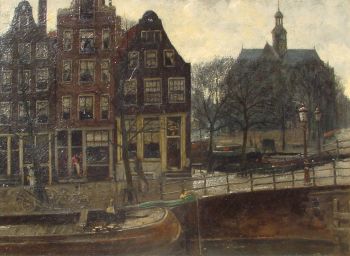
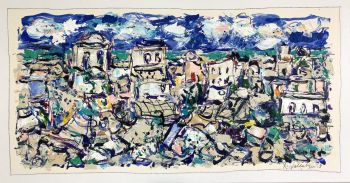
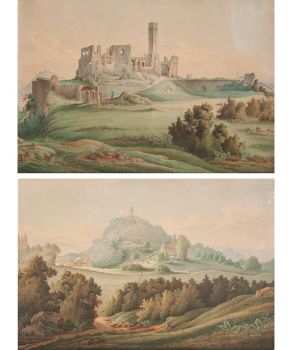
Stylistically, Kaufmann favored working outdoors, employing gouache, watercolor, and ink to capture both urban and pastoral landscapes. He created vivid impressions of Austrian cities such as Salzburg, Vienna, and Graz, yet it was in his depictions of sport and everyday life that his sense of rhythm and vitality most clearly emerged. His post-war works, alive with motion and human energy, stand as testaments to resilience and renewal in a fractured century.
Wilhelm Kaufmann died in 1975, leaving behind a body of work that bridges tradition and modernity, hardship and hope.
































![[copy] #515 150 x 150 cm | gemengde techniek op linnen by Charlot Terhaar sive Droste](https://media-3.gallerease.com/images/d1eb2027-e615-4da4-9789-bf94ce332fed/350x350/copy-515-150-x-150-cm-gemengde-techniek-op-linnen.jpg)