Sul l'artista
Camille Mauclair, born Séverin Faust on 29 November 1872 in Paris, was a remarkable dual talent: he achieved fame as a writer, poet, critic and painter. In his work — both literary and visual — the sensory experience was central. He was a defender of beauty, silence and poetry in an age that increasingly tended towards speed and modernity.
As a young man, Mauclair was active in symbolist circles. He wrote poetry, novels and essays, and contributed to influential magazines such as La Revue Blanche. His literary style was lyrical and philosophical, imbued with melancholy, mysticism and longing for the past. But he was above all an astute art critic. In this role he passionately defended the Impressionists, Symbolists and Post-Impressionists — particularly Gustave Moreau, Odilon Redon and later also Claude Monet and Auguste Rodin. His books on art had a great influence in fin-de-siècle France and beyond.
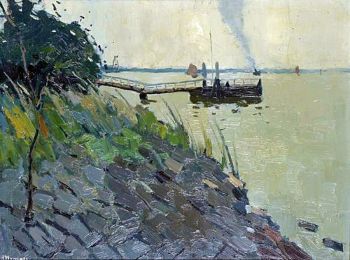
Around 1900, Mauclair himself began to paint actively. His painting was strongly influenced by the Impressionists, especially in his use of color and composition. He painted landscapes, harbor scenes, interiors, and Provencal scenes, often with soft contours and a dreamy atmosphere. His style was subdued, lyrical, and figurative—a countermovement to the emerging modernism of cubism and abstraction.
Mauclair believed in the “soul of the landscape”: he wanted to depict not only what he saw, but also what he felt about it. As a result, his paintings show not only trees, air, and water, but also silence, memory, and emotion. His work was regularly exhibited in Parisian salons and regional galleries in the 1910s–1930s.
Although he became somewhat conservative in his views in his later years—he strongly opposed avant-garde movements such as surrealism and abstraction—he remained an outspoken advocate of beauty, harmony, and craftsmanship in art.
Camille Mauclair died on 23 April 1945 in his native Paris, at the end of the Second World War. His name lives on in both French literary history and art criticism, but his paintings have remained largely unknown outside specialist circles.
Yet his oeuvre deserves to be re-evaluated: as a unique example of a man who not only wanted to describe his world, but also wanted to paint it — with words and light, with paint and feeling.
Opere d'arte
Filter Opere d'arte
1 opere d'arte in vendita da Camille Mauclair

Opere correlate in vendita

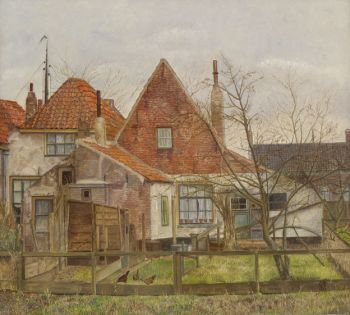
Tjitske Geertruida Maria van Hettinga Tromp
ACHTER HET HUIS1872 - 1962
Prezzo su richiestaGalerie Het Noorderlicht








Peter van Straten
Be at peace, there is so much space2024
Prezzo su richiestaArt-Gallery The Obsession of Art