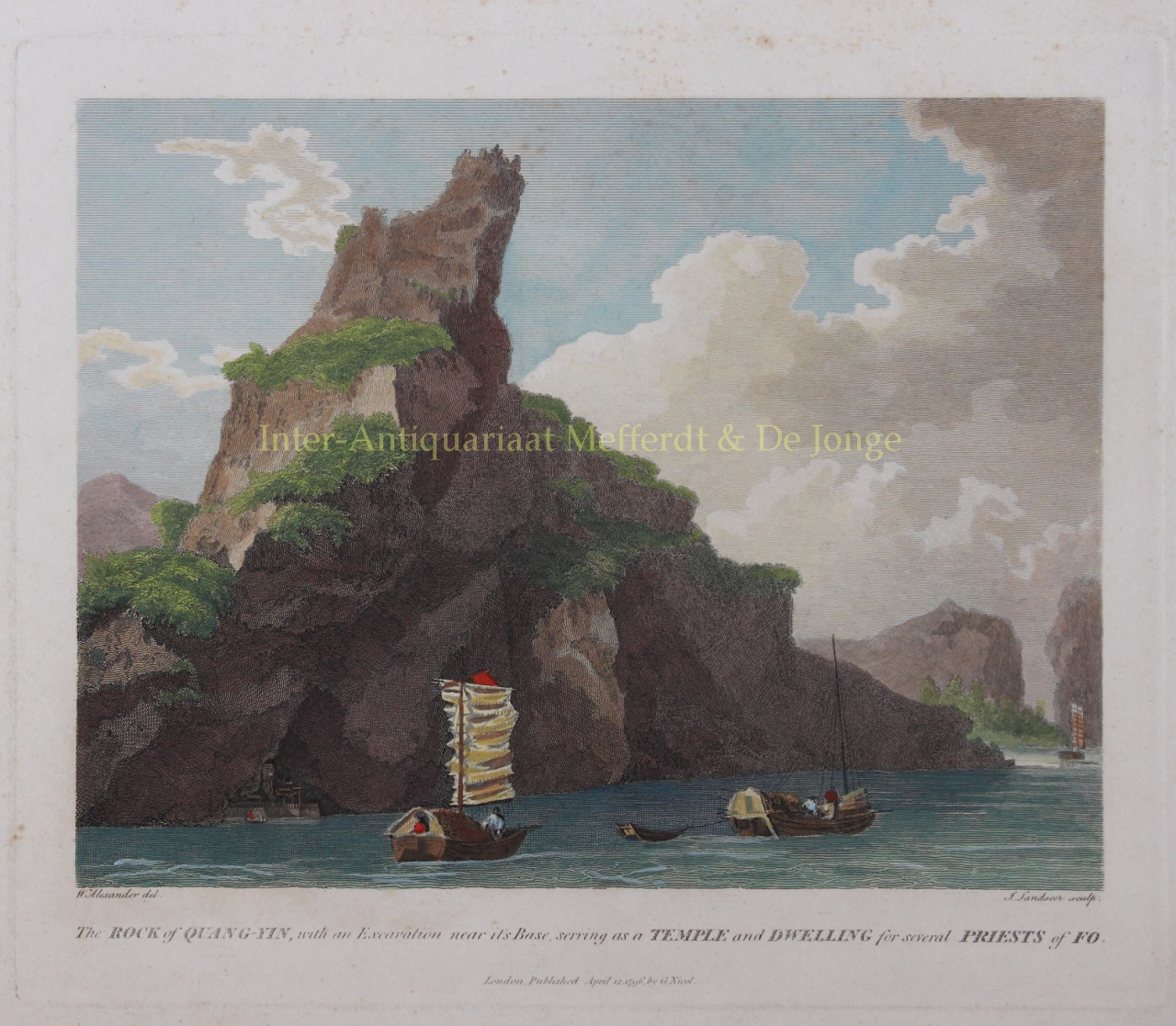
Cina, Rocca di Quang - Yin 1796
William Alexander
€ 195
Inter-Antiquariaat Mefferdt & De Jonge
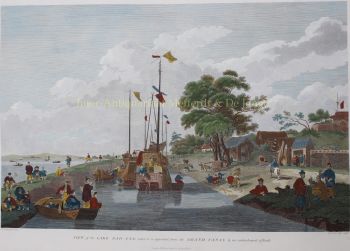
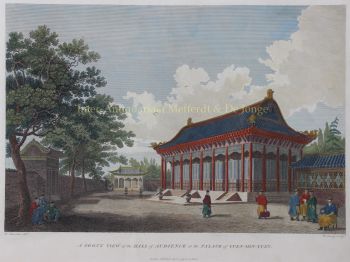
- A proposito di opere d'arteThe Rock of Quang-Yin, with an Excavation near its Base, serving as a Temple and Dwelling for several, priests of Fo.” Copper engraving by John Landseer after a drawing by William Alexander (1767-1816 ) from the “Authentic account of an embassy from the King of Great Britain to the Emperor of China; including cursory observations made, and information obtained, in travelling through that ancient empire” written by Sir George Leonard Staunton and published April 12, 1796 in London by G. Nicol. Coloured by a later hand. Size (image): 17,3 x 22,4 cm. The embassy was headed by Earl George Macartney (1737-1806), who was dispatched to Beijing in 1792. He was accompanied by Staunton a medical doctor as his secretary, and a retinue of suitably impressive size, including Staunton’s 11-year-old son who was nominally the ambassador’s page. On the embassy’s arrival in China it emerged that the 11-year-old was the only European member of the embassy able to speak Mandarin, and thus the only one able to converse with the Emperor. Lord Macartney's embassy was unsuccessful, the Chinese resisting British overtures to establish diplomatic relations in view of opening the vast Chinese realms to free trade, but it opened the way for future British missions, which would eventually lead to the first Opium War and the cession of Hong Kong to Britain in 1842. It also resulted in this invaluable account, prepared at government expense, largely from Lord Macartney's notes, by Staunton, of Chinese manners, customs and artifacts at the height of the Qing dynasty. The engravings are of special interest because of their depiction of subjects that very few Europeans had heard of or seen, showing how advanced Chinese civilisation was on a technical, artistic and organizational level. Staunton describes the stupendous Rock of Quang-Yin as follows: On one side of the river was an immense rock of grey coarse marble, estimated to be about six hundred feet in height. In a large rent or fissure close to the water's edge, and accessible only by boats, is a [Buddhist] temple, inhabited by Ho-shaung, or priests of Fo, who worship there a variety of chiefs or heroes deified, and of virtues and passions personified. This temple consisted of several apartments, one over the other, of considerable height, consisting chiefly of excavations made into the rock. Above them, in a large natural fissure, was an immense mass of stalactites not less, apparently, than a ton in weight, out of which proceeded a vast number of ramifications." Price: Euro 195,-
- A proposito di opere artista
William Alexander (1767–1816) fu l'unico artista inglese della fine del XVIII secolo ad addentrarsi nell'entroterra cinese, un viaggio che avrebbe segnato la sua carriera e consolidato la sua reputazione. Nato a Maidstone, nel Kent, figlio di un carrozziere, mostrò presto un talento artistico e studiò a Londra, probabilmente sotto la guida di Giulio Cesare Ibbetson, prima di entrare alla Royal Academy Schools.
Nel 1792 Alexander si unì all'ambasciata britannica di Lord Macartney in Cina come disegnatore junior. Sebbene la missione diplomatica non riuscisse a stabilire relazioni commerciali durature con l'imperatore Qianlong, fornì ad Alexander uno straordinario materiale di prima mano. In un'epoca in cui le cineserie affascinavano l'Europa, i suoi acquerelli dettagliati di paesaggi, architettura e vita quotidiana cinesi ottennero ampi consensi. Molti furono incisi per il resoconto ufficiale dell'ambasciata e per pubblicazioni come "View of the Headlands, Islands, etc." (1798) e "A Voyage to Cochin China" di John Barrow (1806).
Tornato in Inghilterra, Alexander perfezionò i suoi schizzi cinesi trasformandoli in opere da esposizione per la Royal Academy e lavorò nel vivace circolo di acquerellisti attorno al Dottor Monro, al fianco di artisti come Thomas Girtin. Nel 1802 divenne professore di disegno paesaggistico presso la Royal Military Academy di Great Marlow.
Nel 1808 si dimise da questo incarico per diventare uno dei primi curatori del British Museum, ricoprendo il ruolo di Conservatore delle Stampe e dei Disegni e assistente bibliotecario. Lì iniziò a compilare il primo inventario di stampe e disegni del museo e illustrò importanti antichità della collezione Townley. Membro della Society of Antiquaries, Alexander si dedicò in seguito sempre più a paesaggi pittoreschi e studi di oggetti classici.
Morì nel 1816 a Maidstone, all'età di quarantanove anni. Oggi, le sue opere sono conservate in importanti collezioni pubbliche, tra cui la British Library, la Tate e il Victoria and Albert Museum, e rimangono una preziosa testimonianza visiva della Cina di fine XVIII secolo vista attraverso gli occhi britannici.

Sei interessato ad acquistare questa opera d'arte?
Artwork details
Related artworks
- 1 - 4 / 12
- 1 - 4 / 24
- 1 - 4 / 12