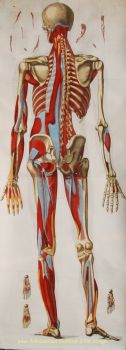
Anatomy - Jan Wandelaar after Bernhard Siegfried Albinus 1742 - 1747
Onbekende Kunstenaar
AfdrukkenGegraveerd
62 ⨯ 47 cm
€ 1.250
Inter-Antiquariaat Mefferdt & De Jonge
- Over kunstwerkMAGNIFICENT PLATES FROM THE MOST ARTISTICALLY PERFECT ANATOMICAL ATLAS Copper engravings made between 1739-1743 by Jan Wandelaar for Bernhard Siegfried Albinus‘ famous “Tabulae Sceleti et Musculorum Corporis Humani” published in 1747 in Leiden by Johan and Herman Verbeek. Size: 62 x 47,5 cm (each). Tabulae Sceleti et Musculorum Corporis Humani was arguably the most important illustrated anatomical work of the Eighteenth Century. Anatomist Bernhard Siegfried Albinus (1697-1770) who was professor at Leiden university, and engraver Jan Wandelaar (1690–1759) collaborated closely to create engravings that were scientifically accurate and exceptionally visually appealing. In an attempt to increase the scientific accuracy of anatomical illustration, Albinus and Wandelaar devised a new technique of placing nets with square webbing at specified intervals between the artist and the anatomical specimen and copying the images using the grid patterns. Albinus believed in the idea of "homo perfectus", an idealized perfect human model based on which all humans were derived as variants. In order to represent this perfect human, the illustrations were drawn from multiple specimens. Earlier anatomical depictions such as those accompanying Andreas Vesalius' work (which Albinus had edited earlier) were drawn from single specimens. The anatomical figures were placed in lush, elaborate Baroque landscapes and architecture, giving the figures a spatial context, added aesthetic interest, and created an illusion of vitality. Wandelaar made the first prints in 1742, including depictions of skeletons with a rhinoceros. Which was the famous Indian rhinoceros Clara, who was staying in Leiden at the time and was immensely popular. Tabulae was criticized by such scholars as Petrus Camper, especially for the whimsical backgrounds, but Albinus staunchly defended Wandelaar. Wandelaar made the first of the plates in 1742, well before the publication of the Tabulae, and this included the skeleton superposed in front of a rhinoceros. This was the famous rhinoceros Clara which at that time stayed in Leiden and was extremely popular. Albinus believed so strongly in the work that he is said to have spent 24,000 florin -about €1,9 million today- to produce it. His investment provided plates that are incomparable and widely considered to rank among the best in engraving history. Prior to meeting Albinus, Jan Wandelaar was already an accomplished natural history artist. He studied with Dutch printmaker Jacob Folkema, Dutch engraver and mapmaker Willem van der Gouwen, painter Gérard de Lairesse, and botanist and anatomist Frederik Ruysch. From 1746 until his death, Wandelaar lived in Albinus's house. Price: Euro 1.250,- (each)
- Over kunstenaar
Het kan voorkomen dat een kunstenaar of maker onbekend is.
Voor sommige werken is het niet te bepalen door wie het gemaakt is of dat het is gemaakt door (een groep) ambachtslieden. Voorbeelden zijn beelden uit de Oudheid, meubels, spiegels of handtekeningen die vaak niet duidelijk of leesbaar zijn. Maar ook sommige werken zijn helemaal niet gesigneerd.
Ook kunt u de volgende beschrijving vinden:
•"Toegeschreven aan …." waarschijnlijk een werk van de kunstenaar maar niet zeker of gedeeltelijk
•“Atelier van ….” of werkplaats van” een werk uitgevoerd in het atelier of atelier van de kunstenaar, eventueel onder zijn toezicht
•“Cirkel van ….” een werk uit de periode van de kunstenaar die zijn invloed laat zien, nauw verbonden met de kunstenaar maar niet noodzakelijkerwijs zijn leerling
•“Stijl van ….” of “Volger van ….” een werk uitgevoerd in de stijl van de kunstenaar, maar niet noodzakelijk door een leerling; kan eigentijds of bijna eigentijds zijn
•“Wijze van ….” een werk in de stijl van de kunstenaar maar van latere datum
•"Na …." een kopie (van welke datum dan ook) van een werk van de kunstenaar
•“Getekend…”, “Gedateerd….” of “Ingeschreven” dan is het werk gesigneerd/ gedateerd/ ingeschreven door de kunstenaar. De toevoeging van een vraagteken duidt op een element van twijfel
•"Met handtekening ...", "Met datum ...", "Met opschrift..." of “Draagt signatuur/datum/opschrift” dan is de handtekening/datum/opschrift toegevoegd door iemand anders dan de kunstenaar

Bent u geïnteresseerd om dit kunstwerk te kopen?
Artwork details
Related artworks
- 1 - 4 / 12
- 1 - 4 / 24
- 1 - 4 / 24
- 1 - 4 / 24
- 1 - 4 / 24
- 1 - 4 / 12


![RARE ARMORIAL MAP: LEO BRABANTIAE Lion of the most noble Duchy of Brabant] by Sibertus Waterloos](https://media-3.gallerease.com/images/325cc033-a3b6-495f-9da8-6d06caf29b14/350x350/rare-armorial-map-leo-brabantiae-lion-of-the-most-noble-duchy-of-brabant.jpg)