Adolf Stademann
BiographyAbout the artist
Adolf Stademann (1824-1895) was a German painter, born and died in Munich. He specialized in landscapes and genre paintings, with a particular focus on winter scenes and moonlit scenes. His work was influenced by Dutch landscape painting from the 17th century.
Stademann studied at the Academy of Fine Arts in Munich under Carl August Lebschée and Moritz Lotze. His early works show a close observation of nature and a refined use of light and color, which suited the taste of his time.
Between 1860 and 1890, Stademann visited the Netherlands several times. He was inspired by Andreas Schelfhout, one of the best-known interpreters of the Dutch ice scene, and began to paint Dutch ice scenes. These skating scenes were popular both in the Netherlands and abroad because of their typically Dutch character.
Museums such as the Neue Pinakothek and the Schack-Galerie in Munich, as well as museums in Frankfurt, Lübeck and Winterthur, have his works in their collections.
Stademann's paintings are characterized by their atmospheric depiction of winter landscapes and night scenes, in which he masterfully captured the play of light and shadow. His attention to detail and his ability to capture the essence of the winter landscape make his work an enduring part of 19th-century German painting.
Related artworks for sale



Isaac Israels
Vrouw in groene jurk aan het punteren1913 - 1915
Price on requestWilliam Jansen Fine Art




Valentine Willaert Fontan
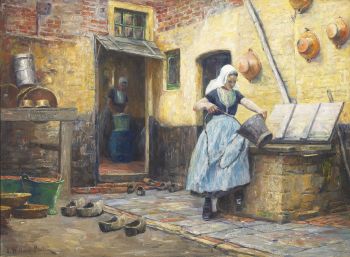
ZEEUWSE MEISJES BIJ DE WATERPUT1892 - 1939
Price on requestGalerie Het Noorderlicht






Gijsbertus Jan Sijthoff
Interior scene with a woman doing needlework1890 - 1920
Price on requestVan der Aalst Fine Art