About the artist
Samuel Leser Schwarz, better known as Mommie Schwarz (July 28, 1876 – November 19, 1942), was a Dutch-Jewish painter, printmaker, and book cover designer. He is considered a key representative of the Bergen School, an artist group that combined Expressionist and Cubist influences in a dark, powerful use of color. Together with his wife, the artist Else Berg, he formed a renowned artistic duo. Both were murdered in Auschwitz in 1942.
Schwarz was born the tenth child of eleven children, to Leser Schwarz and Julie Winter. In 1897, he and his brother Julius moved to New York City, where he stayed for several years. In 1902, he returned to Europe and enrolled in evening classes at the Royal Academy of Fine Arts in Antwerp. He returned to New York again in 1903. Around 1908 or 1909, he returned to Europe permanently. In Berlin, he visited his cousins, including Else Berg, with whom he subsequently traveled to Paris. Around 1909/1910, they settled in the Netherlands.
In 1915, Schwarz and Berg moved to Schoorl, where they associated with artists of the Bergen School, including Leo Gestel. Later, they were also associated with artists such as Charley Toorop. In 1920, the couple married and moved to Amsterdam. From 1927 onward, they lived in Sarphatipark. The couple traveled extensively, visiting Mallorca, the former Yugoslavia, Turkey, and Spain, among other places.
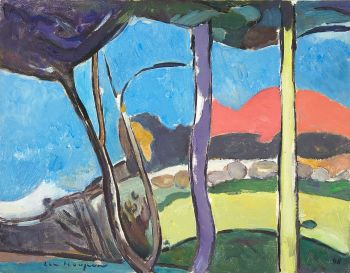
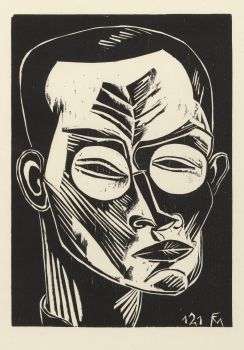
Schwarz's work consists of harbor scenes, landscapes, portraits, and still lifes, executed in a style characterized by dark tones, bold contours, and a certain monumentality. The influence of Cubism and Expressionism is clearly visible, entirely in the spirit of the Bergen School. One of his last known works is "View of Sarphatipark" (c. 1942), a painting that depicts his immediate surroundings in Amsterdam. In addition to his painting, he worked as an illustrator and designed book covers and posters, including for the Dutch art magazine Wendingen.
During the German occupation of World War II, Schwarz and Berg refused to go into hiding or wear the Star of David. On November 12, 1942, they were arrested and deported via Westerbork transit camp to Auschwitz, where they were murdered immediately upon arrival on November 19, 1942. His life and work form a compelling part of both Dutch art history and the history of the Holocaust.