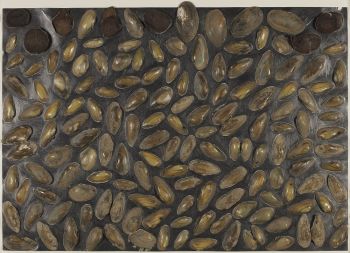
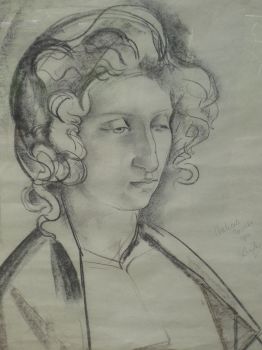
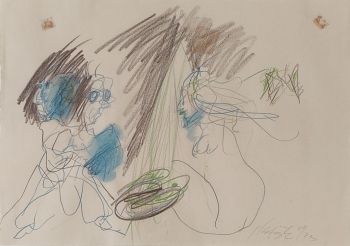
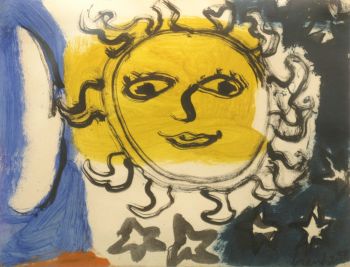
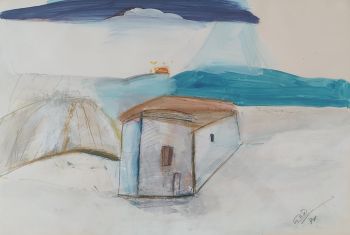
Carel Visser's oeuvre spans an entire lifetime: the early years with mainly studies in a more or less figurative visual language, the fifties and sixties with mainly iron abstractions of geometric shapes, stacks of plates and beams, studies of tilts and reflections and experimental wall sculptures in aluminium. The seventies and eighties are characterised by a completely free visual language and a particularly varied use of materials, in which Visser did not shy away from any material.
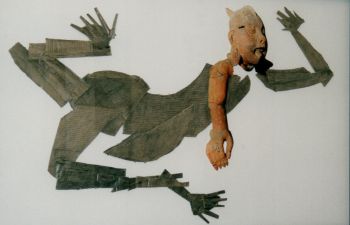
He remained active and creative until he reached an advanced age, but he increasingly traded in the heavy iron for the equally expressive and spatial collage in the light cardboard.
As the son of a civil engineer, Carel Visser was familiar with architectural materials and techniques from an early age. Initially, he studied architecture at the Technical University of Delft, but this study did not captivate him permanently. He also left the Royal Academy in The Hague prematurely to become a drawing teacher. With his younger brother Geertjan he already made several trips to France, Spain and Italy. These trips have had a great influence on his evolving interest from architecture to sculpture. The high-profile and influential exhibitions at the Stedelijk Museum under Sandberg have been important and formative for the young fisherman. That was certainly the exhibition 13 Sculptors from Paris in 1948, where he first became acquainted with the work of Brancusi, Arp, Gonzalez and Giacometti, among others. Taking nature and figuration as his starting point, Visser slowly but surely developed into a sculptor for whom abstraction and architecture would dominate his formal language. He is one of those modern sculptors for whom figuration is not the obvious outcome of sculpture.
In the Netherlands his work was mainly represented by Nouvelles Images in The Hague and Art & Project in Amsterdam; abroad mainly by Konrad Fischer in Düsseldorf and Galerie Durand-Dessert in Paris.