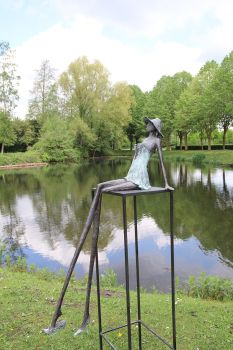
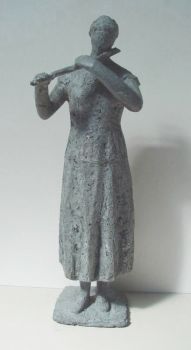
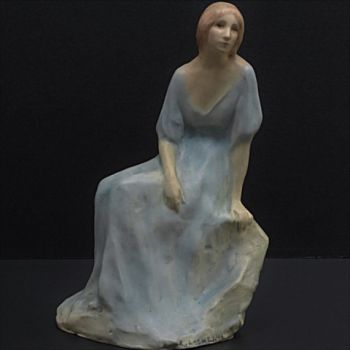
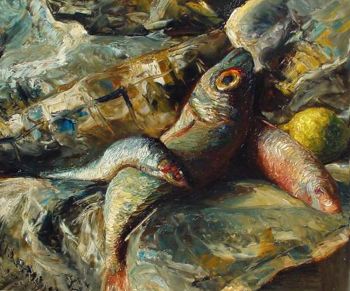
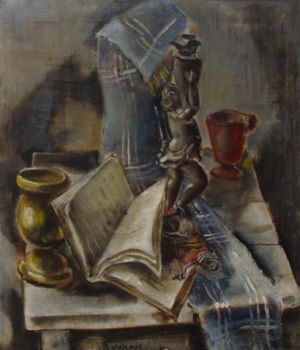
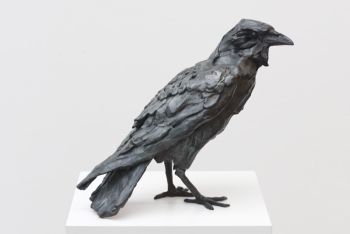
Fred Carasso (Carignano, near Turin, 1899 – Amsterdam, 1969) was an Italian-Dutch sculptor known for his socially engaged, monumental sculptures and his influence on post-war Dutch sculpture. His oeuvre reflects a combination of Italian modernist traditions, political conviction and a search for a universal, powerful formal language.
Born into a working-class family in Piedmont, Carasso grew up in a time of social unrest and political struggle, which profoundly shaped his worldview. He joined anarchist and socialist movements at a young age, a commitment that would characterize him throughout his life. In Italy he became involved in anti-fascist activities and eventually had to flee the Mussolini regime.
In the 1920s he ended up in Paris, where he came into contact with avant-garde movements and artists such as Ossip Zadkine, with whom he became friends. In Paris he immersed himself in modern sculptural techniques and developed a style in which powerful, simplified forms were combined with expressive movement and tension.
In order to escape political persecution, Carasso settled in the Netherlands in the early 1930s. He found a new home base in Amsterdam, where he actively participated in the cultural and political life of the left-wing intelligentsia. During the Second World War he went into hiding for a while and remained active in the resistance. His experience with oppression and the fight against injustice formed a lasting source of inspiration for his work.
After 1945, Carasso made a name for himself as a maker of monumental sculptures and war memorials. In his sculptures he managed to combine a sober monumentality with an intense human expressiveness. Well-known works include the resistance monument in Hoorn (1950) and the monument for the fallen railwaymen in Utrecht (1949), which are still reminders of his ability to unite collective remembrance and personal emotion in a powerful image.
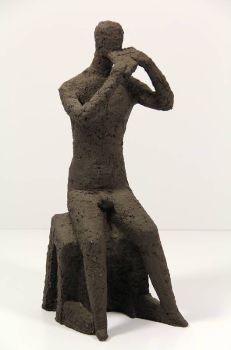
His style continued to evolve: from rather expressionistic forms he shifted to a tighter, often geometric formal language without ever losing the human dimension. Carasso's sculptures often show a tension between abstraction and recognisability, between mass and movement, and testify to a desire to express social themes in a universal way.
In addition to his own work, Carasso was also an important teacher for young sculptors in the Netherlands. He contributed to the post-war revival of monumental art and stimulated the debate on the role of art in public space and society.
Fred Carasso remained active as an artist and committed citizen until his death in 1969. His work reflects a lifelong commitment to human dignity, freedom and solidarity – values that he managed to portray not only in his political choices, but also in bronze, stone and clay. His oeuvre can still be seen in the Dutch streetscape and forms a lasting memory of an artist who managed to inextricably link art and engagement.