Powered byPowered by Gallerease
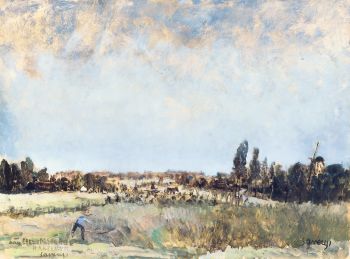
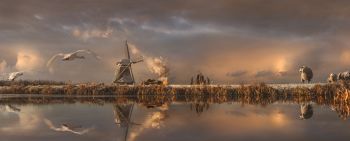
Wipmolen in de polder by Cornelis Vreedenburgh

Wipmolen in de polder 1900 - 1940

Cornelis Vreedenburgh

Original oil on canvas
29 ⨯ 44 cm
Price on request

Bruning Heintz Fine Art

  • About the artwork
    Grootte 44 x 29 cm
    Signatuur Rechtsonder
    Materiaal Olieverf op paneel
    Stroming Klassiek impressionisme
    Provenance Particuliere collectie

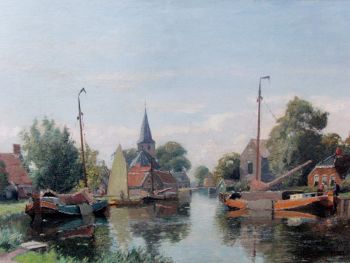
    Veel Hollandser wordt het niet: een wipmolen aan het water in een polderlandschap. Dit werk is een Vreedenburgh ten voeten uit. Deze grote impressionist, geboren in Woerden in 1880, werkte graag in het Groene hart. Hij schilderde daar boerderijen, weidelandschappen, waterlandschappen met bootjes etcetera. Dit schilderij met wipmolen past daar naadloos bij. Een wipmolen is overigens een type windmolen dat vooral in Nederland en België voorkomt en een van de oudste vormen van windmolens is. Dit type molen werd voornamelijk gebruikt voor het bemalen van polders en het verplaatsen van water. De wipmolen heeft een rechthoekig houten bovenhuis, de kast, dat op een vaste onderbouw staat en kan draaien om de windrichting te volgen. De onderbouw, vaak van steen of hout, blijft stil terwijl het bovenhuis beweegt. Meestal werd een wipmolen ingezet als poldermolen, waarbij hij met een scheprad of vijzel water kon verplaatsen. Door zijn slanke en eenvoudige constructie is hij gemakkelijk te herkennen. Deze molens komen vooral voor in waterrijke gebieden zoals het Groene Hart, Noord-Holland en Friesland en vormen een belangrijk onderdeel van het Nederlandse waterbeheer en cultureel erfgoed.
  • About the artist

    Cornelis Vreedenburgh (25 August 1880 – 27 June 1946) was a Dutch painter, known for his atmospheric depictions of cityscapes and landscapes. Born in Woerden, the Netherlands, he developed a passion for art at an early age, influenced by his father Gerrit Vreedenburgh, who was himself a painter.

    Education and Influences

    Although Vreedenburgh was largely self-taught, he received valuable advice from the impressionist painter Willem Bastiaan Tholen. Together with Tholen, he explored the inland lakes and wide rivers of the Netherlands, capturing the vast skies and open waters. These experiences had a lasting influence on his work, especially in his depiction of light and reflections on water.

    Career and Recognition

    In 1904, Vreedenburgh received a royal grant for promising young artists, allowing him to focus entirely on his painting. His entry at Arti et Amicitiae was awarded the Willink van Collen Prize, and he became a member of both Arti et Amicitiae and Pulchri Studio. His work quickly became popular for its vibrant colours and the way he captured the light and atmosphere of the Dutch landscape.

    Personal Life

    After marrying artist Marie Schotel in 1912, Vreedenburgh settled in Laren, a bustling artists' village at the time. Here he painted many cityscapes of Amsterdam, capturing the charm and character of the city. His work was recognised by Queen Wilhelmina in 1937, who purchased two of his paintings.

    Legacy

    Cornelis Vreedenburgh died on 27 June 1946 in Laren. His paintings remain valued for their technical skill and ability to capture the essence of the Dutch landscape and city life. His work can be found in several museums and private collections, and he is remembered as an important figure in Dutch art history.

Are you interested in buying this artwork?