A pair of Dutch Colonial Solid Satinwood Chairs, Ceylon 18th century by Artiste Inconnu

A pair of Dutch Colonial Solid Satinwood Chairs, Ceylon 18th century 1725 - 1750

Artiste Inconnu

101 ⨯ 75 ⨯ 50 cm
ConditionGood
Prix sur demande

Menken Works of Art

  • Sur l'oeuvre d'art
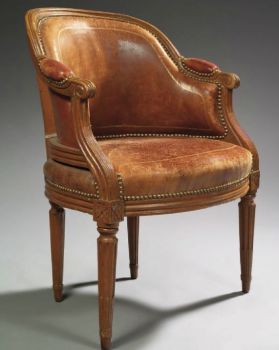
    A pair of Dutch colonial solid satinwood chairs.
    Galle, Ceylon (Sri Lanka), c. 1725-1750.

    The chairs are richly carved, featuring a shell motif at the crest of the backrest, flanked by two birds with open lion-like mouths. Furthermore with floral and acanthus leaf carvings, shell motifs, and claw feet.

    Crafted from Ceylon Satinwood (Chloroxylon swietenia), these chairs were most likely made by Sinhalese artisans in the Black Town (Pettah) district of Colombo during the VOC (Dutch East India Company) period in Dutch Ceylon (1664–1795).

    Such satinwood furniture, reflecting Dutch stylistic preferences, was favored by both Europeans and affluent Sinhalese families. While the overall form and decorative elements are inspired by 18th-century European models, the incorporation of carved birds—identified by R.L. Brohier as Garuda, the eagle mount of Vishnu—and the detailed carving reflect distinctive Sinhalese craftsmanship.

    Dimensions:
    Height 101 cm, width 75 cm, depth 50 cm, seat height 44 cm.

    Condition report and more pictures available upon request.

    Ref:
    An identical chair can be found in the Asian Civilisations Museum, Singapore (accession number 2015-00480).

    Also compare with a pair of chairs of the same design but with a different stretcher underneath the seating in the Cleveland Museum of Art (accession number 1922.677).

    Another similar chair, but with red and gold lacquer-work is in the Museum Sejarah Jakarta and illustrated in Furniture From Indonesia, Sri Lanka and India (Jan Veenendaal, 1985), p. 100, pl. 108.

    Other identical examples can be found in the Wolvendaal (Dutch Reformed) Church in Colombo, Sri Lanka and illustrated in situ in Furniture of the Dutch Period in Ceylon (R.L. Brohier, 1969), p. 14, fig. 14 and pl. X|||, fig. 4.

    Furthermore an identical chair is illustrated in Asian Art and the Dutch Taste (Jan Veenendaal, 2014), p. 63, pl. 92.

    Inv. No: MW270
  • Sur l'artiste

    Il peut arriver qu'un artiste ou un créateur soit inconnu.

    Certaines œuvres ne doivent pas être déterminées par qui elles sont faites ou elles sont faites par (un groupe d') artisans. Les exemples sont des statues de l'Antiquité, des meubles, des miroirs ou des signatures qui ne sont pas claires ou lisibles, mais aussi certaines œuvres ne sont pas signées du tout.

    Vous pouvez également trouver la description suivante :

    •"Attribué à …." A leur avis probablement une oeuvre de l'artiste, au moins en partie

    •« Atelier de …. ou « Atelier de » À leur avis, une œuvre exécutée dans l'atelier ou l'atelier de l'artiste, éventuellement sous sa direction

    •« Cercle de… ». A leur avis une oeuvre de la période de l'artiste témoignant de son influence, étroitement associée à l'artiste mais pas forcément son élève

    •« Style de … ». ou "Suiveur de ...." Selon eux, une œuvre exécutée dans le style de l'artiste mais pas nécessairement par un élève ; peut être contemporain ou presque contemporain

    •« Manière de… ». A leur avis une oeuvre dans le style de l'artiste mais d'une date plus tardive

    •"Après …." A leur avis une copie (quelle qu'en soit la date) d'une oeuvre de l'artiste

    •« Signé… », « Daté… ». ou « Inscrit » À leur avis, l'œuvre a été signée/datée/inscrite par l'artiste. L'ajout d'un point d'interrogation indique un élément de doute

    • "Avec signature ….", "Avec date ….", "Avec inscription …." ou "Porte signature/date/inscription" à leur avis la signature/date/inscription a été ajoutée par quelqu'un d'autre que l'artiste

Êtes-vous intéressé par l'achat de cette oeuvre?