Isaac de la Croix
BiographyAbout the artist
Isaac de la Croix (1765–1834) was a Dutch painter and engraver known for his refined use of light and shadow, and his unusual combination of classical and oriental influences. Born in Leiden to a cartographer and a bookbinder’s daughter, Isaac grew up in an environment full of maps, ink, and stories of faraway lands—a breeding ground that would strongly influence his later work.
De la Croix showed a remarkable talent for drawing from an early age. At the age of twelve, he was admitted to the prestigious Leiden Drawing School, where he learned traditional techniques. But De la Croix always sought further. Around the age of twenty, he broke with prevailing conventions and began experimenting with techniques he discovered through Persian miniatures and Chinese landscapes, often via the books his father had in the house.
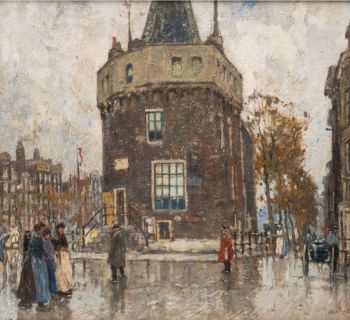
His early work consisted mainly of tranquil cityscapes, in which the human presence was rendered subtly and almost melancholically. In his later years, De la Croix developed a preference for allegorical scenes — often mythical or Biblical scenes — in which he used the interplay of light and dark as a carrier of emotion and mystery. This earned him the nickname "the Shadow Master of Leiden".
In 1803, De la Croix travelled to Paris, where he studied briefly at the École des Beaux-Arts. There he became friends with artists associated with the emerging Romantic movement. Yet his style always remained difficult to pigeonhole: too refined for pure Classicism, too subdued for flamboyant Romanticism.
Back in the Netherlands, despite his artistic idiosyncrasy, he was respected as a teacher. He taught a small circle of students, including the later famous landscape painter Jan van Bree.
Isaac de la Croix died in 1834 in his native city of Leiden. He left behind a relatively small oeuvre — only about sixty paintings and a handful of etchings — but his influence reached further than the amount of work suggests. His quest for cultural fusion and his subtle depiction of human desire made him a bridge builder between styles, times and worlds.
Today, most of his works are in private collections, but a few key pieces hang in the Rijksmuseum and Museum De Lakenhal in Leiden, where they bear witness to an artist who was far ahead of his time.
Artworks
Filter Artworks
1 artwork for sale by Isaac de la Croix

Related artworks for sale

Jannes de Vries
Het Boterdiep bij Bedum op een winterse avond1920 - 1980
Price on requestBruning Heintz Fine Art





Rudolf de Bruyn Ouboter
Still life with red bowl, blue salt cellar, weck jar and Japanese print1940 - 1960
Price on requestAdelwein Kunst






Cornelis Vreedenburgh
Het atelier van de schilder aan de Vredelaan 1 te Laren1920 - 1940
Price on requestBruning Heintz Fine Art