About the artist
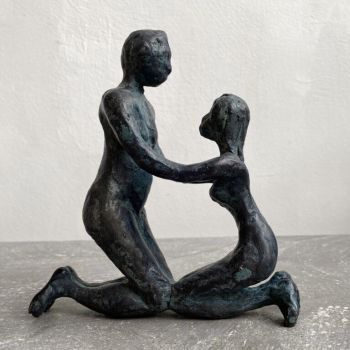
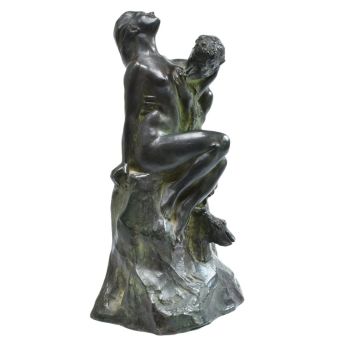
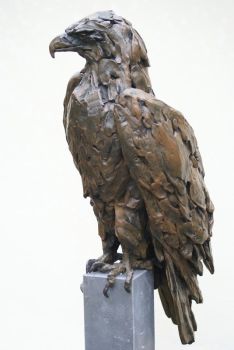
Jan Wolkers (1925–2007) is often remembered primarily as a writer, but he considered himself at least as much a visual artist. After the Second World War, he studied at the School of Applied Arts and the Rijksakademie in Amsterdam, where he developed his expressive and direct visual language. For Wolkers, visual art was not a sideline, but an essential part of his artistic practice, in which nature, physicality, and transience recurred repeatedly.
His sculptures and monuments have acquired a permanent place in public spaces throughout the Netherlands. The Auschwitz Monument in Amsterdam's Wertheimpark is particularly well-known, in which he used broken mirrors to make the incompleteness and destruction of the war tangible. The Revolution Monument in Vlissingen and countless other memorials also demonstrate how Wolkers managed to give shape to the tension between beauty and fragility, between memory and transience. He frequently used glass, bronze, and steel, materials that express both strength and vulnerability.
In addition to monumental work, Wolkers created paintings, drawings, and prints. His paintings are colorful and expressive, often inspired by flowers, gardens, animals, and landscapes. After moving to Texel, nature became an even more prominent source of inspiration and imagination. The cycle of life and death resonates in both his paintings and sculptures, as does the intense vitality and sensuality that are also so characteristic of his literary work.
Although his visual work was long overshadowed by his writing, it has received widespread recognition through exhibitions at venues including the Rijksmuseum, the Cobra Museum, and Museum De Lakenhal. Today, Wolkers is regarded as a multidisciplinary artist who successfully interweaved literature and visual art, and whose sculptures, paintings, and monuments continue to testify to his love of nature, his sensitivity to materiality, and his confrontational perspective on human existence.