About the artist
Joé Descomps-Cormier, born Emmanuel-Jules-Joseph Descomps on January 18, 1869 in Clermont-Ferrand, France, was a versatile artist who achieved recognition as both a sculptor and a goldsmith. He trained with Louis-Auguste Hiolin and Alexandre Falguière, which laid the foundation for his future career.
From 1891 to 1937, Descomps-Cormier exhibited regularly at the Salon des Artistes Français, where he received several awards: an honorable mention in 1898, a third medal in 1921, a second in 1925, and a first medal in 1928. His participation in the Chicago World's Fair in 1893 and his collaboration with jeweler Frédéric Boucheron underlined his international reputation.
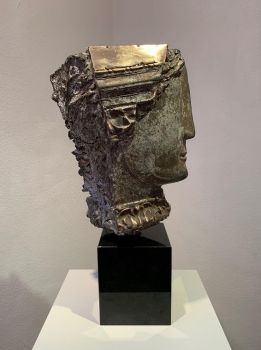
Descomps-Cormier's oeuvre includes a wide range of works, ranging from bronze and ivory sculptures to jewelry in the Art Nouveau style. In the 1920s, his focus shifted to smaller sculptures in the Art Deco style, often executed in bronze and ivory. His sculptures, such as 'Danaïde' and 'Artémis', are in the collections of leading Parisian museums.
A notable moment in his career was his participation in the art competition at the 1924 Summer Olympics in Paris, where his work was exhibited in the sculpture category.
After World War I, he began signing his works with the name 'Cormier'. His studio was located in La Charité-sur-Loire. On April 3, 1929, Descomps-Cormier was made a Knight of the Legion of Honor, in recognition of his contributions to French art.
Joé Descomps-Cormier died on April 24, 1950 in Paris, but his legacy lives on in the many works of art that are still admired in museums and private collections worldwide.
Related artworks for sale






Unknown artist
A white jade ‘Lotus Seedpod and Bug’ carving, Qing dynasty, 18th century18th century
Price on requestMenken Works of Art


Unknown artist
Chinese gilt bronze censer, Xuande mark, 18th century, Qing dynasty18th century
Price on requestMenken Works of Art