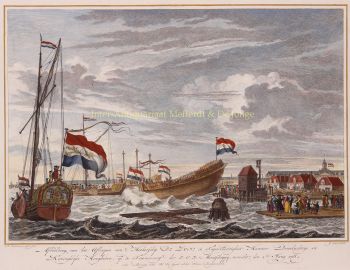
Hendrik de Leth (Amsterdam, May 31, 1703 - Amsterdam, June 17, 1766) was a print artist, etcher, engraver, mapmaker, draftsman, bookseller, art dealer, publisher of prints, art collector and naturalia collector.
Hendrik de Leth was the son of Andries de Leth (plate cutter, bookseller, 1662-1731) and Nelletje Middenheespen. Hendrik had an older brother, Christiaan de Leth. In 1742 Hendrik married Sophia Otto, who died in 1753. Their marriage remained childless. It was likely that nephew Andries, son of Hendrik's brother Christiaan, would become the successor to Hendrik's business. However, he died in 1743. In 1766 Hendrik de Leth had a will drawn up just before his death, whereby Catharina le Blanc, granddaughter of brother Christiaan, became heiress. On September 30, 1766, the auction of his estate took place.[3]
In 1728, Hendrik joined the booksellers' guild. Before that he was a student of his father Andries de Leth, who had taken over the map, print and art dealership 'Op de Beurssluys, in den Visscher' in Amsterdam from the cartographer and printmaker Nicolaas Visscher II. Hendrik de Leth in turn took over this company after the death of his father in 1731.
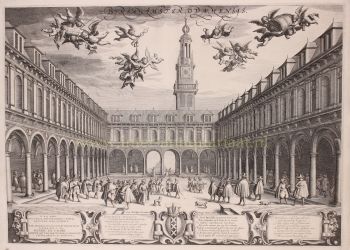
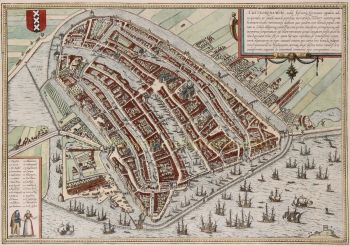
As early as 1725, the work Images of the Wijdtvermaarde city of Amsterdam was published in addition to its most important Buildings and Gesites, all accurately drawn after life and published in Amsterdam.
His best-known work with 100 prints was published in 1730: The blessing splendor Kennemerlant : shows many glorious faces of the latter's most important pleasure places, noble houses, village and town buildings : starting with Kastrikum (...) / drawn after life and in the copper brought by H. de Leth; and briefly described by M. Brouërius van Nidek. - Amsterdam : De Leth, 1730. Many prints that De Leth made of Amsterdam can be found in the Amsterdam City Archives.
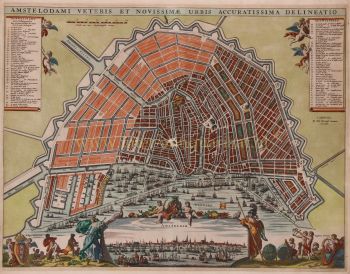
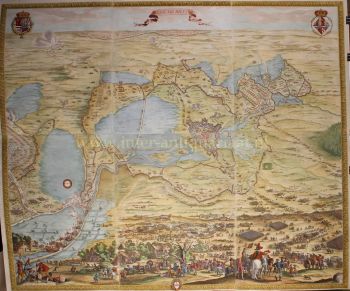
As a cartographer, De Leth was best known for his New Geographical Atlas and Historical Atlas, Van de Zeven Vereenigde Nederlandsche Provintien, published in 1740. De Leth also became known for the copper engravings he made around 1758 of the General Map of the Colony or Province of Suriname after the design of Alexander de Lavaux.