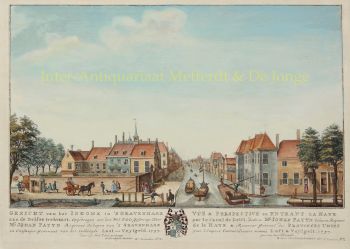
Amsterdam, Nieuwezijds Voorburgwal - Andries and Hendrik de Leth, c. 1725 1725
Hendrik Leth
PapelImprimir
58 ⨯ 92 cm
Atualmente indisponível via Gallerease
- Sobre arteNIEUWEZIJDS VOORBURGWAL AMSTERDAM “Afbeelding van het Stadhuys van agteren van de Weeszluis langs de Blom Markt aan te sien/ Representation de la maison de Ville Sur le Derrier du Coté d'Occident, ver la Marché aux Fleurs.” Etching with engraving printed from two copper plates made by Andries de Leth and published by Hendrik de Leth around 1725. With original hand colouring. Size: 58,4 x 92 cm. Handsomely frames. From the Weessluis bridge (litt: 'orphan's sluice', named after the nearby orphanage) we see the Nieuwezijds Voorburgwal with in the distance the backside of the impressive town hall (from 1808 Royal Palace of Amsterdam), on the left there is the flower market. In the past, Amsterdammers bought their flowers, plants and trees – just like other products – on the market. Different markets existed for different commodities. The market on the Nieuwezijds Voorburgwal was the most important flower market in the city in the 18th century. The traders often brought in their goods by boat and moored here to sell their flowers and plants. (In 1862 the flower market moved to the Singel, between the Munt and the Koningsplein.) On the other side of the water there is the "pijpenmarkt" the pipe market, where tobacco pipes (made from clay) were unloaded and traded. At the pijpenmarkt there were jetties for ships to unloaded their cargo, coming from factories many of which were in the city of Gouda. From the same quay a little further on, the trekschuit (litt: "towing barge", a ferry service also meant for passengers) also departed for Gouda. Closer are ships for the ferry to Noordwijk. Sailing ships that is, for travelling to Noordwijk is along the coast. Behind the town hall is the basis of the unfinished tower of the Nieuwe Kerk. (In 1783 this basis was largely demolished.) The Nieuwezijds Voorburgwal was filled in in 1884, the weessluis bridge was demolished in the process. Price: Euro 4.950,- (incl. frame)
- Sobre artista
Hendrik de Leth (Amsterdã, 31 de maio de 1703 - Amsterdã, 17 de junho de 1766) foi um impressor, gravador, gravador, cartógrafo, desenhista, livreiro, negociante de arte, editor de gravuras, colecionador de arte e colecionador de naturalia.
Hendrik de Leth era filho de Andries de Leth (cortador de chapas, livreiro, 1662-1731) e Nelletje Middenheespen. Hendrik tinha um irmão mais velho, Christiaan de Leth. Em 1742, Hendrik casou-se com Sophia Otto, que morreu em 1753. O casamento deles não teve filhos. Era provável que o sobrinho Andries, filho do irmão de Hendrik, Christiaan, se tornasse o sucessor dos negócios de Hendrik. No entanto, ele morreu em 1743. Em 1766, Hendrik de Leth fez um testamento pouco antes de sua morte, pelo qual Catharina le Blanc, neta do irmão Christiaan, tornou-se herdeira. Em 30 de setembro de 1766, ocorreu o leilão de sua propriedade.[3]
Em 1728, Hendrik ingressou na guilda dos livreiros. Antes disso, ele foi aluno de seu pai Andries de Leth, que assumiu o mapa, impressão e negociante de arte 'Op de Beurssluys, em den Visscher' em Amsterdã do cartógrafo e gravador Nicolaas Visscher II. Hendrik de Leth, por sua vez, assumiu esta empresa após a morte de seu pai em 1731.
Já em 1725, a obra Imagens da cidade Wijdtvermaarde de Amsterdã foi publicada, além de seus mais importantes Edifícios e Gesites, todos desenhados com precisão após a vida e publicados em Amsterdã.
Seu trabalho mais conhecido com 100 impressões foi publicado em 1730: O esplendor da bênção Kennemerlant : mostra muitas faces gloriosas dos locais de lazer mais importantes deste último, casas nobres, vilas e edifícios da cidade : começando com Kastrikum (...) / desenhado após a vida e no cobre trazido por H. de Leth; e brevemente descrito por M. Brouërius van Nidek. - Amsterdã: De Leth, 1730. Muitas gravuras feitas por De Leth em Amsterdã podem ser encontradas nos Arquivos da cidade de Amsterdã.
Como cartógrafo, De Leth era mais conhecido por seu Novo Atlas Geográfico e Atlas Histórico, Van de Zeven Vereenigde Nederlandsche Provintien, publicado em 1740. De Leth também ficou conhecido pelas gravuras em cobre que fez por volta de 1758 do Mapa Geral da Colônia ou Província do Suriname segundo o desenho de Alexander de Lavaux.

Artwork details
Related artworks
- 1 - 1 / 1
- 1 - 4 / 24
Cornelis Anthonisz Theunissen
MUITO RARO PRIMEIRO MAPA IMPRESSO DE AMESTERDÃO, UMA CIDADE EM ASCENSÃO1544
€ 125.000Inter-Antiquariaat Mefferdt & De Jonge
Com curadoria deDanny Bree
Jean-François Rauzier
Balade d'Amsterdam 4 - Limited edition of 22015 - 2024
Preço em pedidoVilla del Arte Galleries
1 - 4 / 24- 1 - 4 / 24