Compositie 1967 1967
Willem Hussem
Original oil on canvas
110 ⨯ 65 cm
Price on request
Bruning Heintz Fine Art
- About the artworkGedateerd: 1967
Grootte: 110 x 65 cm
Signatuur: Rechtsonder. In verso genummerd H4 317 (bekend in het archief van Dürst Britt & Mayhew)
Materiaal: Olieverf op jute
Stroming: Nieuwe Haagse School
Provenance: Particuliere collectie, voorheen galerie Erik Paol, daarvoor galerie Nouvelles Images
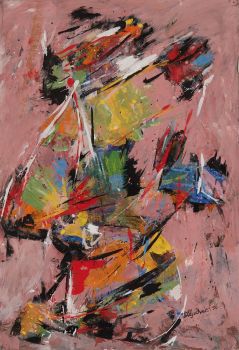
Het schilderij uit 1967 van Willem Hussem ontvouwt zich als een stille, doordachte compositie waarin eenvoud en beweging elkaar ontmoeten. Tegen een warme, zalmroze achtergrond schuiven grote, afgeronde vormen het beeld binnen, alsof ze net buiten het doek hun oorsprong hebben. Een brede, witte baan slingert zich door het midden, kruist zichzelf en verbindt de verschillende vlakken met een vanzelfsprekende rust. Het wit is niet strak of klinisch, maar levendig en tastbaar; je ziet hoe de verf is aangebracht, hoe de hand van de kunstenaar nog aanwezig is in elke streek. Aan de randen verschijnen diepe kleurvelden, d.w.z. een intens rood dat overgaat in zwart linksonder, een helder blauw met een donker accent rechtsboven, en een donker, bijna aards vlak linksboven. Deze vormen lijken afgesneden, als fragmenten van een groter geheel dat zich buiten het kader voortzet. Juist daardoor krijgt het schilderij een zekere spanning: het is tegelijk begrensd en open, ingetogen en dynamisch. Wat het werk bijzonder maakt, is de balans die Hussem weet te vinden. De ronde vormen verzachten, terwijl de witte banen richting geven en structuur aanbrengen. Alles lijkt op zijn plaats, zonder dat het statisch wordt. Het schilderij ademt een kalme ritmiek, een soort visuele muziek waarin elke vorm en kleur precies op het juiste moment klinkt. De originele aluminium lijst omlijst het geheel op subtiele wijze. Het koele, sobere materiaal contrasteert mooi met de warme kleuren en de zichtbare penseelstreken, zonder de aandacht op te eisen. Integendeel, de lijst versterkt de helderheid van de compositie en geeft het werk een tijdloze, bijna architectonische uitstraling. Dit past goed bij de abstracte vormentaal van de jaren zestig. Zo vormt het schilderij, samen met zijn aluminium lijst, een harmonieus geheel: ingetogen, maar krachtig; eenvoudig, maar rijk aan nuance. Een werk dat niet schreeuwt om aandacht, maar die stil en overtuigend vasthoudt.
Willem Hussem’s 1967 painting unfolds as a quiet, thoughtful composition in which simplicity and movement meet. Against a warm, salmon-pink background, large, rounded forms slide into the image, as if they originate just outside the canvas. A broad, white band winds through the center, crosses itself, and connects the various planes with a self-evident calm. The white is not stark or clinical, but lively and tangible; you can see how the paint has been applied, how the artist’s hand is still present in every stroke. Deep fields of color appear at the edges: an intense red transitioning into black in the lower left, a bright blue with a dark accent in the upper right, and a dark, almost earthy plane in the upper left. These forms appear cut off, like fragments of a larger whole that continues beyond the frame. It is precisely this that gives the painting a certain tension: it is simultaneously bounded and open, restrained and dynamic. What makes the work special is the balance Hussem manages to strike. The round forms soften, while the white stripes provide direction and add structure. Everything seems to be in place without becoming static. The painting exudes a calm rhythm, a kind of visual music in which every form and color strikes at precisely the right moment. The original aluminum frame subtly frames the whole. The cool, austere material contrasts beautifully with the warm colors and visible brushstrokes, without demanding attention. On the contrary, the frame enhances the clarity of the composition and gives the work a timeless, almost architectural appearance. This fits well with the abstract visual language of the sixties. Thus, the painting, together with its aluminum frame, forms a harmonious whole: restrained yet powerful; simple yet rich in nuance. A work that does not scream for attention, but holds it quietly and convincingly. - About the artist
Willem Frans Karel Hussem (born in Rotterdam on January 29, 1900, died in The Hague on July 21, 1974) was a versatile Dutch artist, known as a painter, sculptor and poet.
Hussem received his training from Dirk Nijland and took lessons at the Rotterdam Academy. Between 1918 and 1936 he stayed in Paris, where he made contacts with leading artists such as Piet Mondriaan and Pablo Picasso. The influence of Picasso and Vincent van Gogh is clearly noticeable in his style.
In 1936, Hussem finally chose The Hague as his home base, where he settled in the Mijtensstraat in the Schilderswijk. After the Second World War his art evolved towards abstraction. He was active in art movements such as Fugare, the Liga Nieuw Beelden and Verve, and his work is associated with the New Hague School.
Despite his national and international recognition, including winning the Jacob Maris Prize three times (1952 and 1955 for painting, 1958 for drawing) and an invitation to the Venice Biennale, his family lived in modest circumstances.
His works of art are part of the collections of: Kunstmuseum The Hague, Stedelijk Museum Amsterdam, Dordrechts Museum and the Rijksmuseum Twenthe in Enschede
The Posthoorngroep formed around Hussem, a collective of artists who were involved in painting, poetry, or both. This group was named after a well-known catering establishment in The Hague.
As a poet and illustrator, Hussem made his debut in 1940 with "The Coast Line", published by L.J.C. Boucher, followed by "Sea View" at A.A.M. Stols in 1941. He also illustrated with a pen drawing of trees in "Een lied van Isoude" by P.C. Boutens (1941). In the 1960s he published several collections of poetry, including the well-known "Voor twee dacharren bluebekken" (1966). His poetry, often enriched with his own illustrations, continued to appear after his death, the last being "Say with ink" (2011). Hussem maintained a friendship with Simon Carmiggelt.
From 1967 onwards Hussem started creating metal sculptures.
A tragic incident involved an aluminum artwork by Hussem, estimated at approximately 100,000 euros, which was accidentally destroyed in 2017 during the demolition of a post office in Raalte. The work of art was one of the last objects to be destroyed in a shredder because the project developer had not been informed of its cultural value.

Are you interested in buying this artwork?
Artwork details
Related artworks
- 1 - 4 / 24
Nicolaas van der Waay
Binnenterrein van het burgerweeshuis te Amsterdam 1890 - 1930
Price on requestBruning Heintz Fine Art
1 - 4 / 24- 1 - 4 / 24
- 1 - 4 / 12