Johannes van Dreght junior (Joannes). Born in Amsterdam and baptized on November 14, 1737 in the Reformed Amstel Church. His father was a ‘white worker’, i.e. he made white metal objects such as knives and scissors. The following information about Joannes’ career as a painter is mainly derived from the book “In de ban van het beeld, stellen over geschiedenis en kunst” (In the spell of the image, essays on history and art) by Dedalo Carasso.
Joannes began his career in the studio of the artist Jacobus van Velsen. On July 4, 1758, he acquired citizenship of Amsterdam, and a few days later he became a member of the St. Lucas Guild by purchase. On May 29, 1761, Joannes van Dreght entered into a pre-marital agreement, married on June 14, 1761, with Hendrina van Leeuwen (baptized Amsterdam March 15, 1733), and they had three daughters. They lived in the Kerkstraat, not far from the Amstel.
Membership of the St. Lucasgilde was a kind of middle-class diploma. Anyone who wanted to count artistically in Amsterdam in the second half of the eighteenth century had to move in the circle of the Amsterdam city drawing academy, a society of prominent citizens and artists, divided into three classes on the basis of ability. Joannes van Dreght enrolled at the drawing academy on 19 November 1766, of which he remained a member until 1802. His talent was appreciated. In 1768 he received the first prize in the third class. He went to the second class and won the first prize again in 1769.
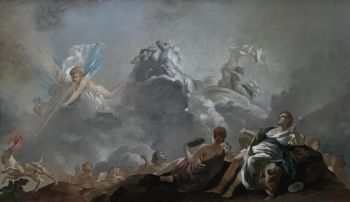
In 1773 he finally received the gold medal of the first class. When an exhibition hall for artists of the academy was set up in the Amsterdam city hall on the Dam, he was the only one to make use of this facility. He painted landscapes and figures (grisailles). In addition to easel paintings or portfolio drawings, he mainly worked in the applied plane. He produced decorative work such as the hall of the Hollandsche Schouwburg in Amsterdam in 1774. Quite a lot of his decorative work has stood the test of time. He was one of the many artists who provided for the need for painted wallpaper, luxury carriages, ceremonial sleighs, pleasure yachts, carriages, fireplaces, decors, fans, etc.
He also painted large decorative pieces with "court views" and ceiling paintings for various houses (including chimney pieces in the town hall in 1772, in the buildings Herengracht 518 and 520 and in the Corvershof in 1778). He also painted stage sets for the Amsterdam theatre. He had a wealthy and artistically developed clientele. His work bears witness to a new vision of classical antiquity, neoclassicism; Joannes van Dreght was the most outspoken neoclassicist among Dutch painters. He probably also had pedagogical qualities, because he had relatively many (around twelve or thirteen) pupils. The wallpaper painter Jurriaan Andriessen was one of his pupils. The later famous poet Willem Bilderdijk owed his skills as a draughtsman and etcher to the teaching of Joannes van Dreght, who had been his teacher for ten years from around 1770.
On 3 November 1779, Johannes van Dregt bought a house and yard on the south side of Amstelkerkstraat (now Kerkstraat), between Amstel and Utrechtsestraat; on 28 January 1806 he sold this house again. Politically, Joannes preferred the patriots, who were quite charmed by the Roman Republic. When in 1781 and 1792 “The Barber of Sevilla”, a play by Beaumarchais, was performed in the city theatre, Van Dreght painted the scenery. From 1787 onwards he profiled himself even more sharply as a patriot and made paintings with a pronounced political tendency. In 1795 he collaborated on the decorations that were erected on the squares of Amsterdam during the festivities in honour of the Batavian-French Alliance.
After that he was not heard from again, he seems to have withdrawn during his last years. Johannes van Dreght died on 7 October 1807 and was buried on 12 October 1807 in the Nieuwezijds Kapel in Amsterdam. Death notice:
“It pleased the Supreme Being, my esteemed Husband, JOHANNES VAN DRECHT, Artist-Painter, after a slow decline of strength, at the age of almost 70 years, after a pleasant marriage of over 46 years, to snatch from my loving arms. Please inform friends and acquaintances of this, for me and my children, painful loss, requesting that letters of condolence be spared.
Amsterdam, 7 October 1807, HENDRINA VAN LEEUWEN, Widow JOHANNES VAN DRECHT.”
Van Dreght's work has been preserved in, among others, the De Lakenhal Museum in Leiden, the Westfries Museum in Hoorn, the Hooigracht 38 mansion in Leiden, the Boymans-van Beuningen Museum in Rotterdam, the Rijksmuseum.Kröller-Müller in Otterlo, the Rijksprentenkabinet in Amsterdam, the Corvershof in Amsterdam, and the Bilderdijkmuseum in Amsterdam. In April 2010, the municipality of Gilze-Rijen (N.Br.) decided to create a street in Rijen the name ‘Johannes van Dreghtstraat’.
His youngest daughter Anna (born 1768) married Hermanus Klijnveld, pharmacist, in 1794. This couple is part of the ancestors of the actor Willem Royaards. After Hermanus died in 1812, she continued “the Affaire” (i.e. the pharmacy) with an “expert master servant” and her eldest son. This son Jan Dirk Kleynveld was later pharmacist of the second institution in Veenhuizen.