Mauritius 1724
Francois Valentijn
Attualmente non disponibile tramite Gallerease
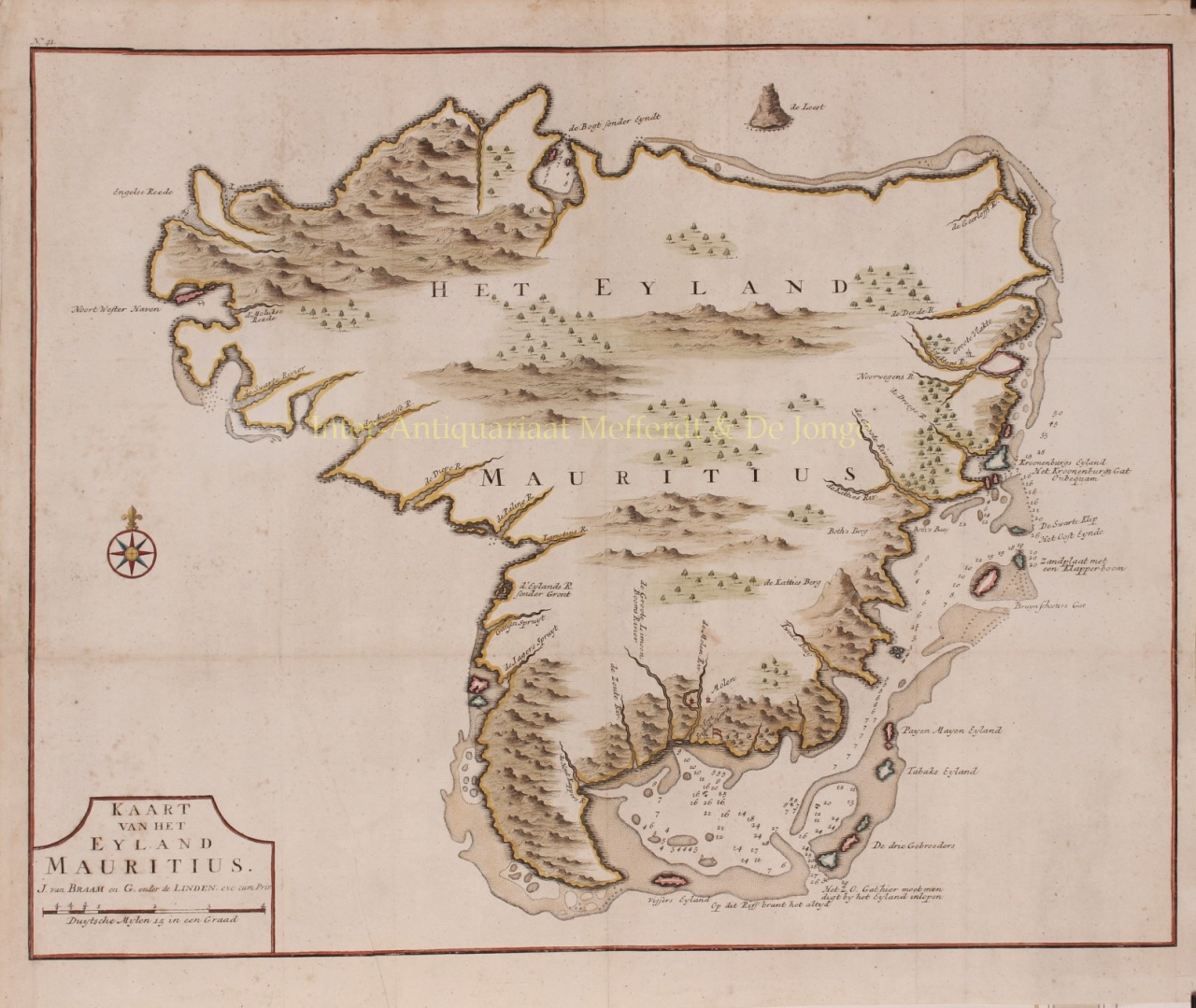
- A proposito di opere d'arte“Kaart van het Eyland Mauritius” [map of the island Mauritius], from François Valentijn’s “Oud en Nieuw Oost-Indien”, after a drawing by Johan van Leenen, engraved by Jan van Braam and published in Dordrecht by Gerard onder de Linden in 1724-1726. Coloured by a later hand. Size.: 43 x 54 cm. Wybrant van Warwijck was the first Dutchman to arrive on Mauritius on September 18, 1598. Van Warwijck had strayed with five ships from the rest of the fleet of the so-called Tweede Schipvaart [second Dutch expedition], trying to reach Madagascar. He is said to have named the green island after Stadtholder Prince Maurice. The Dutch East India Company (VOC) initially only used the island as a refreshment station and did not permanently inhabit it. Mauritius had two good natural harbours suitable for larger ships, in the Northwest "Port de Warwick" (nowadays Port-Louis) and the Southeast. The Northwestern harbour was a sheltered bay and the Southeastern was protected by a series of islands and reefs. Valentijn reports that it was very stormy around February. Mauritius was a fertile island, rich with birds, the most important of which was the dodo for food, turtles and manatees. Pigs, deer and goats were left on the island for meat supply. In the course of the 1630s, the VOC found a permanent settlement necessary to prevent the French or the English from settling there. There were forests of ebony. Cornelis Matelief had planted lemon and orange trees. With the ships rats came to the island, against which in turn cats were released. Dutch colonization started in 1638 and ended in 1710, with a brief interruption between 1658 and 1666. Numerous governors were appointed, but continuous hardships such as cyclones, droughts, pest infestations, lack of food, and illnesses finally took their toll, and the island was definitively abandoned in 1710. Francois Valentijn (1666-1727) was a minister, naturalist and writer who is best known for his Oud en Nieuw Oost-Indien [Old and New East-India], a history of the Dutch East India Company (VOC) and their activities in the East Indies. Valentijn’s maps were among the most accurate and large scale productions detailing the East Indies thus far published. As VOC officer, Valentijn doubtless had access to VOC manuscript records which he complied into his remarkable collection of maps. In fact, Valentijn's maps are so superior to previous maps that their publication itself is rather surprising. The VOC’s policy of extreme secrecy, especially regarding cartographic matters, historically limited publication of their charts. Price: Euro 950,-
- A proposito di opere artista
François Valentijn (Dordrecht, 17 aprile 1666 – L'Aia, 6 agosto 1727) fu un ministro, storico e cronista olandese di eccezionale importanza per la conoscenza dell'Asia all'inizio del XVIII secolo. Fu inviato due volte in Oriente al servizio della Compagnia Olandese delle Indie Orientali (VOC), un'esperienza che costituì la base per la monumentale opera della sua vita, Oud en Nieuw Oost-Indiën (Vecchie e Nuove Indie Orientali).
Dopo essere tornato nei Paesi Bassi, Valentijn si dedicò alla compilazione di quest'opera vasta e ineguagliabile, mai eguagliata per portata e livello di dettaglio. In un'epoca in cui la VOC manteneva le sue informazioni strettamente riservate, riuscì ad accumulare un vasto corpus di conoscenze utilizzando tutte le fonti orali e scritte che riuscì a ottenere. La sua forza risiedeva non solo nella curiosità e nella tenacia, ma anche nel suo talento di narratore: Valentijn scriveva in modo vivido, preciso e con una prospettiva straordinariamente ampia.
In Oud en Nieuw Oost-Indiën (Vecchie e Nuove Indie Orientali), glorificò esplicitamente la potenza e l'impero olandese in Asia. Valentijn era un convinto nazionalista e considerava sua missione principale descrivere la potenza olandese in Oriente e dimostrare così che la Repubblica non aveva perso la forza dei suoi antenati batavi. Nella prefazione alla sua opera, sottolineò il suo desiderio di rendere visibili il progresso e la gloria dei Paesi Bassi nel corso dei secoli.
Questo atteggiamento gli valse la reputazione di storico un po' egocentrico e vanitoso. Eppure, questa critica non sminuisce minimamente il valore duraturo della sua opera. È proprio attraverso le sue descrizioni dettagliate che l'interazione tra europei e asiatici diventa vividamente visibile: non solo i rapporti di potere coloniali, ma anche gli incontri culturali, le incomprensioni e le influenze reciproche trovano spazio nella sua narrazione.
François Valentijn rimane quindi una figura complessa: nazionalista e cronista allo stesso tempo, predicatore e storico, scrittore vanitoso e fonte indispensabile. La sua opera rimane un testo fondamentale per comprendere la presenza olandese in Asia e la più ampia storia mondiale dell'inizio dell'età moderna.

Artwork details
Related artworks
- 1 - 4 / 12
- 1 - 4 / 24