Mauritius  by Francois Valentijn
Scroll to zoom, click for slideshow

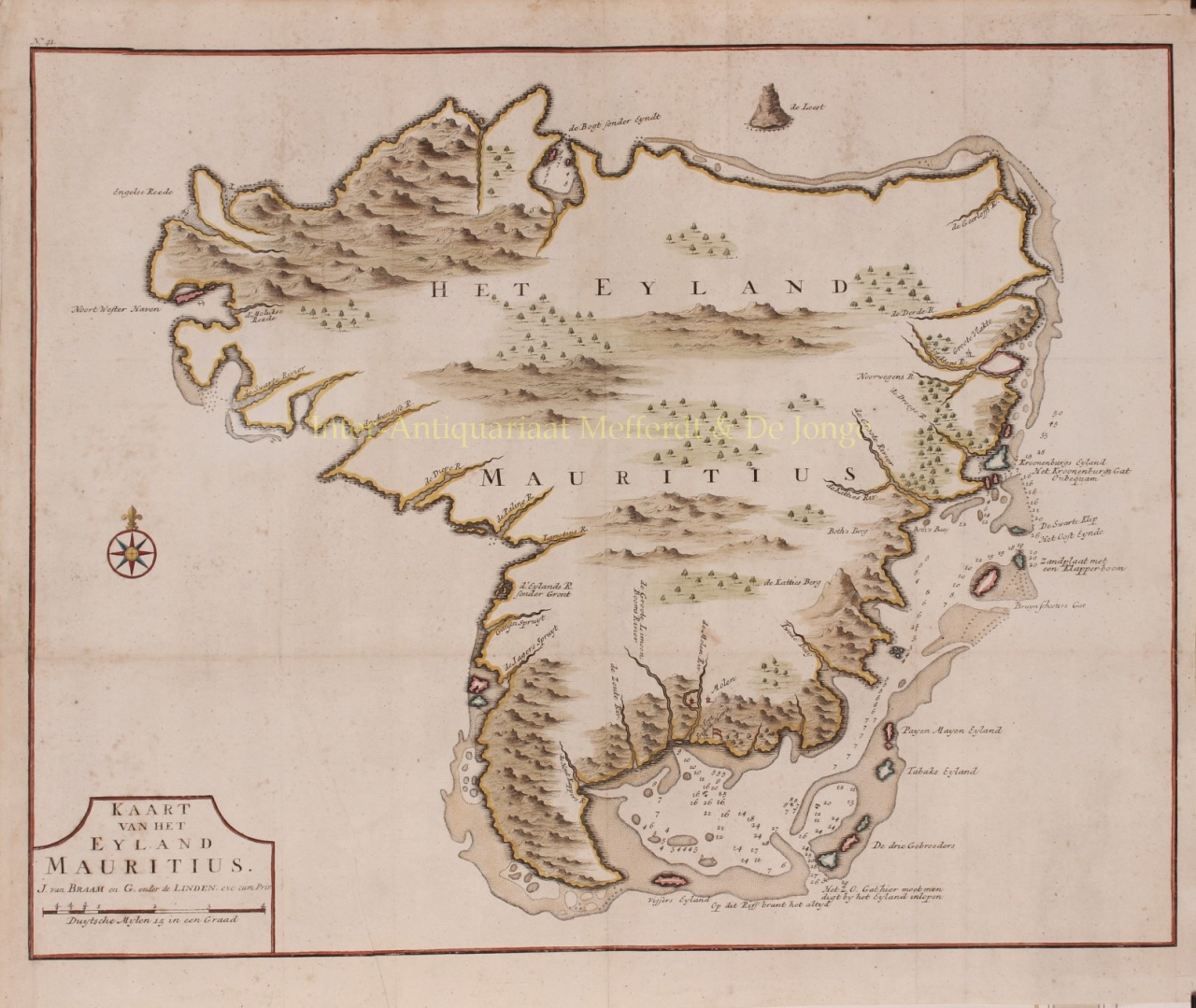
Ile Maurice 1724

Francois Valentijn

Actuellement indisponible via Gallerease

  • Sur l'oeuvre d'art
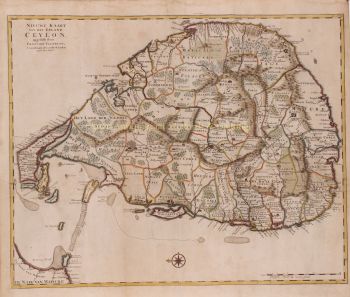
    “Kaart van het Eyland Mauritius” [map of the island Mauritius], from François Valentijn’s “Oud en Nieuw Oost-Indien”, after a drawing by Johan van Leenen, engraved by Jan van Braam and published in Dordrecht by Gerard onder de Linden in 1724-1726. Coloured by a later hand. Size.: 43 x 54 cm. Wybrant van Warwijck was the first Dutchman to arrive on Mauritius on September 18, 1598. Van Warwijck had strayed with five ships from the rest of the fleet of the so-called Tweede Schipvaart [second Dutch expedition], trying to reach Madagascar. He is said to have named the green island after Stadtholder Prince Maurice. The Dutch East India Company (VOC) initially only used the island as a refreshment station and did not permanently inhabit it. Mauritius had two good natural harbours suitable for larger ships, in the Northwest "Port de Warwick" (nowadays Port-Louis) and the Southeast. The Northwestern harbour was a sheltered bay and the Southeastern was protected by a series of islands and reefs. Valentijn reports that it was very stormy around February. Mauritius was a fertile island, rich with birds, the most important of which was the dodo for food, turtles and manatees. Pigs, deer and goats were left on the island for meat supply. In the course of the 1630s, the VOC found a permanent settlement necessary to prevent the French or the English from settling there. There were forests of ebony. Cornelis Matelief had planted lemon and orange trees. With the ships rats came to the island, against which in turn cats were released. Dutch colonization started in 1638 and ended in 1710, with a brief interruption between 1658 and 1666. Numerous governors were appointed, but continuous hardships such as cyclones, droughts, pest infestations, lack of food, and illnesses finally took their toll, and the island was definitively abandoned in 1710. Francois Valentijn (1666-1727) was a minister, naturalist and writer who is best known for his Oud en Nieuw Oost-Indien [Old and New East-India], a history of the Dutch East India Company (VOC) and their activities in the East Indies. Valentijn’s maps were among the most accurate and large scale productions detailing the East Indies thus far published. As VOC officer, Valentijn doubtless had access to VOC manuscript records which he complied into his remarkable collection of maps. In fact, Valentijn's maps are so superior to previous maps that their publication itself is rather surprising. The VOC’s policy of extreme secrecy, especially regarding cartographic matters, historically limited publication of their charts. Price: Euro 950,-
  • Sur l'artiste

    François Valentijn (Dordrecht, 17 avril 1666 – La Haye, 6 août 1727) était un ministre, historien et chroniqueur néerlandais d'une importance exceptionnelle pour la connaissance de l'Asie au début du XVIIIe siècle. Envoyé à deux reprises en Orient au service de la Compagnie néerlandaise des Indes orientales (VOC), il y vécut une expérience qui inspira son œuvre monumentale, Oud en Nieuw Oost-Indiën (Les Anciennes et les Nouvelles Indes orientales).

    De retour aux Pays-Bas, Valentijn se consacra à la compilation de cette œuvre vaste et sans pareille, inégalée par son ampleur et sa précision. À une époque où la VOC exigeait la plus stricte confidentialité, il parvint à rassembler un immense corpus de connaissances en exploitant toutes les sources orales et écrites à sa disposition. Sa force résidait non seulement dans sa curiosité et sa ténacité, mais aussi dans son talent de conteur : Valentijn écrivait avec vivacité, précision et une perspective remarquablement large.

    Dans son ouvrage *Oud en Nieuw Oost-Indiën* (Anciennes et Nouvelles Indes orientales), il glorifiait explicitement la puissance et l'empire néerlandais en Asie. Nationaliste convaincu, Valentijn se donnait pour mission de décrire la puissance néerlandaise en Orient et de démontrer ainsi que la République n'avait rien perdu de la force de ses ancêtres bataves. Dans la préface, il soulignait son désir de rendre visible le progrès et la gloire des Pays-Bas à travers les siècles.

    Cette attitude lui valut la réputation d'un historien quelque peu égocentrique et vaniteux. Pourtant, cette critique n'enlève rien à la valeur inestimable de son œuvre. C'est précisément grâce à ses descriptions détaillées que l'interaction entre Européens et Asiatiques apparaît avec une grande clarté : non seulement les rapports de force coloniaux, mais aussi les rencontres culturelles, les malentendus et les influences mutuelles trouvent leur place dans son récit.

    François Valentijn demeure ainsi une figure complexe : à la fois nationaliste et chroniqueur, prédicateur et historien, écrivain vaniteux et source incontournable. Son œuvre demeure un texte clé pour comprendre la présence néerlandaise en Asie et l'histoire mondiale plus large du début de l'époque moderne.

Artwork details