Mauritius 1724
Francois Valentijn
Momenteel niet beschikbaar via Gallerease
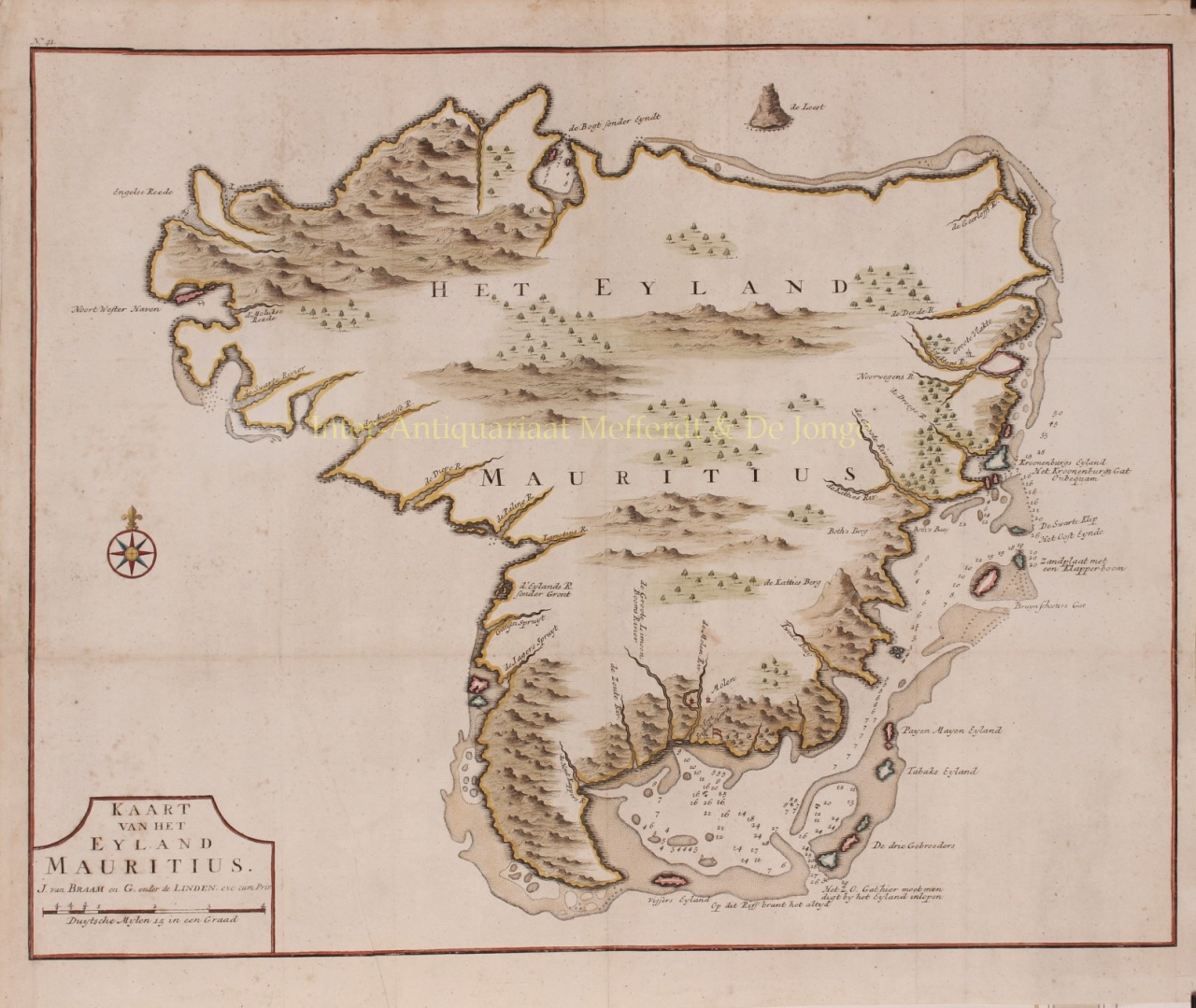
- Over kunstwerk“Kaart van het Eyland Mauritius” [map of the island Mauritius], from François Valentijn’s “Oud en Nieuw Oost-Indien”, after a drawing by Johan van Leenen, engraved by Jan van Braam and published in Dordrecht by Gerard onder de Linden in 1724-1726. Coloured by a later hand. Size.: 43 x 54 cm. Wybrant van Warwijck was the first Dutchman to arrive on Mauritius on September 18, 1598. Van Warwijck had strayed with five ships from the rest of the fleet of the so-called Tweede Schipvaart [second Dutch expedition], trying to reach Madagascar. He is said to have named the green island after Stadtholder Prince Maurice. The Dutch East India Company (VOC) initially only used the island as a refreshment station and did not permanently inhabit it. Mauritius had two good natural harbours suitable for larger ships, in the Northwest "Port de Warwick" (nowadays Port-Louis) and the Southeast. The Northwestern harbour was a sheltered bay and the Southeastern was protected by a series of islands and reefs. Valentijn reports that it was very stormy around February. Mauritius was a fertile island, rich with birds, the most important of which was the dodo for food, turtles and manatees. Pigs, deer and goats were left on the island for meat supply. In the course of the 1630s, the VOC found a permanent settlement necessary to prevent the French or the English from settling there. There were forests of ebony. Cornelis Matelief had planted lemon and orange trees. With the ships rats came to the island, against which in turn cats were released. Dutch colonization started in 1638 and ended in 1710, with a brief interruption between 1658 and 1666. Numerous governors were appointed, but continuous hardships such as cyclones, droughts, pest infestations, lack of food, and illnesses finally took their toll, and the island was definitively abandoned in 1710. Francois Valentijn (1666-1727) was a minister, naturalist and writer who is best known for his Oud en Nieuw Oost-Indien [Old and New East-India], a history of the Dutch East India Company (VOC) and their activities in the East Indies. Valentijn’s maps were among the most accurate and large scale productions detailing the East Indies thus far published. As VOC officer, Valentijn doubtless had access to VOC manuscript records which he complied into his remarkable collection of maps. In fact, Valentijn's maps are so superior to previous maps that their publication itself is rather surprising. The VOC’s policy of extreme secrecy, especially regarding cartographic matters, historically limited publication of their charts. Price: Euro 950,-
- Over kunstenaar
François Valentijn (Dordrecht, 17 april 1666 – Den Haag, 6 augustus 1727) was een Nederlandse predikant, historicus en chroniqueur van uitzonderlijke betekenis voor de kennis van Azië in de vroege achttiende eeuw. Hij werd tweemaal uitgezonden naar “de Oost” in dienst van de Verenigde Oost-Indische Compagnie (VOC), een ervaring die de basis vormde voor zijn monumentale levenswerk Oud en Nieuw Oost-Indiën.
Na zijn terugkeer in Nederland wijdde Valentijn zich aan het samenstellen van dit omvangrijke en ongeëvenaarde werk, dat zowel door zijn reikwijdte als door zijn detailniveau nooit meer is geëvenaard. In een tijd waarin de VOC haar informatie strikt geheim hield, wist hij een enorme hoeveelheid kennis te verzamelen door gebruik te maken van alle mondelinge en schriftelijke bronnen die hij kon bemachtigen. Zijn kracht lag niet alleen in zijn nieuwsgierigheid en vasthoudendheid, maar ook in zijn talent als verteller: Valentijn schreef levendig, precies en met een opvallend brede blik.
In Oud en Nieuw Oost-Indiën verheerlijkte hij expliciet de Nederlandse macht en het imperium in Azië. Valentijn was uitgesproken nationalistisch en zag het als zijn overkoepelende missie om de Nederlandse ‘mogentheyd’ in de Oost te beschrijven en daarmee te tonen dat de Republiek de voortvarendheid van haar Bataafse voorouders niet had verloren. In het voorwoord van zijn werk benadrukte hij dat hij de vooruitgang en glorie van Nederland door de eeuwen heen zichtbaar wilde maken.
Deze houding leverde hem de reputatie op van een enigszins zelfingenomen en ijdele historicus. Toch doet die kritiek weinig af aan de blijvende waarde van zijn werk. Juist door zijn uitvoerige beschrijvingen wordt de wisselwerking tussen Europeanen en Aziaten scherp zichtbaar: niet alleen de koloniale machtsverhoudingen, maar ook culturele ontmoetingen, misverstanden en wederzijdse beïnvloeding krijgen een plaats in zijn relaas.
François Valentijn blijft daarmee een complexe figuur: tegelijk nationalist en chroniqueur, predikant en historicus, ijdel schrijver én onmisbare bron. Zijn werk vormt tot op de dag van vandaag een sleuteltekst voor het begrijpen van de Nederlandse aanwezigheid in Azië en de bredere wereldgeschiedenis van de vroegmoderne tijd.

Artwork details
Related artworks
- 1 - 4 / 12
Gobert Denis Chambon/ Jean Janvier, S.G. Longschamps
Magnificient antiek World map1754
€ 17.500Inter-Antiquariaat Mefferdt & De Jonge
Gecureerd doorDanny Bree
1 - 4 / 24