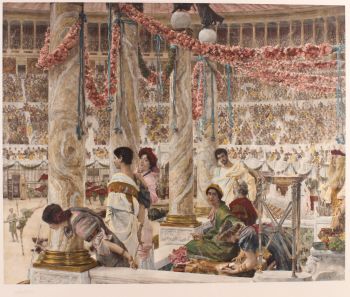
Luigi Bazzani, known as Il Bazzanetto, was not merely a painter of ruins — he was a guardian of memory. Born in Bologna on 8 November 1836, he trained at the Accademia di Belle Arti before embarking on formative travels through France and Germany. Yet it was Rome, where he settled in 1861, that shaped his artistic destiny. There he developed a refined language of genre scenes, theatrical set design, and evocative landscapes, increasingly drawn to the poetic remains of classical antiquity.
Bazzani’s life work would become inseparable from Pompeii. At a time when the rediscovered city still shimmered with traces of original pigments, he recognized the urgency of preservation through paint. From around 1880 to 1915, he devoted some thirty-five years to documenting the excavations in meticulous watercolor studies. His approach went beyond romantic ruin painting; he examined architectural reliefs, wall textures, and chromatic subtleties with near-scientific precision. Chipped marble, fading frescoes, crumbling stucco — each surface was rendered with astonishing technical control and a palette of restrained, atmospheric tones.
Archaeologists valued him not simply as an artist, but as an observer whose eye preserved what time would soon erase. He contributed fourteen illustrations to publications by Pompeii’s leading archaeologist, Amedeo Maiuri, and many interiors he painted have since deteriorated beyond recognition. Today, his works serve as visual archives — documents as much as artworks — bridging art and archaeological scholarship.
Alongside his work in Pompeii, Bazzani maintained an active exhibition career across Rome, Vienna, Munich, Berlin, and Paris from 1895 onward. He also taught perspective and theatrical set design at the Roman academy, influencing a generation of artists with his structural clarity and spatial sensitivity. Membership in several Italian academies confirmed his standing within the artistic establishment.
Long after his death, Bazzani’s relevance endured. In 2013, a major exhibition in Bologna revisited his Pompeian watercolors, digitally reintegrating them into their original architectural settings through advanced imaging technology — a fitting tribute to an artist whose life’s mission was to preserve fleeting beauty.
In Luigi Bazzani’s hands, ruins were never silent. They breathed with color, texture, and the quiet dignity of civilizations suspended between excavation and disappearance.







































!["SKIMMING THE WATER [MENAGE A QUATRE]" Signed book plus small artwork by LAWRENCE WEINER](https://media-2.gallerease.com/images/442bfd5f-fc31-4e18-a2fa-ee0c08eade64/350x350/skimming-the-water-menage-a-quatre-signed-book-plus-small-artwork.jpg)