Moon - Homann, Doppelmayr, Hevelius by Johann Baptist Homann
Scroll to zoom, click for slideshow

Moon - Homann, Doppelmayr, Hevelius 1742 - 1748

Johann Baptist Homann

Paper
48 ⨯ 58 cm
€ 1.950

Inter-Antiquariaat Mefferdt & De Jonge

  • About the artwork
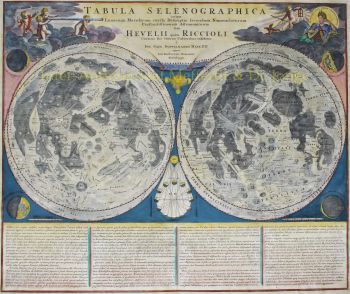
    IMPORTANT MAP OF THE MOON “Tabula Selenographica in qua Lunarium Macularum exacta Descriptio secundum Nomenclaturam … Hevelii quam Riccioli”. Copper engraving made by Johann Baptist Homann after Johann Gabriel Doppelmayr, from the Atlas Coelestis in quo Mundus Spectabilis published in Nuremberg in 1742 or 1748. Coloured by a later hand. Size c. 48,5 x 58 cm. The left hand lunar map, composed by Johannes Hevelius, is a considered a foundational map in the science of Selenography – or lunar cartography. This map first appeared in Hevelius’ 1647 work Selenographia which laid the groundwork for most subsequent lunar cartographic studies. Here the moon is presented as it can never be seen from Earth, at a greater than 360 degrees and with all visible features given equal weight. In this map Hevelius also establishes the convention of mapping the lunar surface as if illuminated from a single source – in this case morning light. The naming conventions he set forth, which associate lunar features with terrestrial locations such as “Asia Minor”, “Persia”, “Sicilia”, etc. were popular until the middle of the 18th century when Giovanni Battista Riccioli’s nomenclature took precedence. The Riccioli map, on the right, is more properly known as the Riccioli-Grimaldi map, after fellow Jesuit Francesco Grimaldi with whom Riccioli composed the chart. This map first appeared in Riccioli and Grimaldi’s 1651 Almagestum Novum. This was a significant lunar chart and offered an entirely new nomenclature which, for the most part, is still in use today. Curiously, though Riccioli, as a devout Jesuit, composed several treatises denouncing Copernican theory, he chose to name one of the Moon’s most notable features after the astronomer – perhaps suggesting that he was a secret Copernicus sympathizer? Other well-known lunar features named by Riccioli include the Sea of Tranquility where Apollo 11 landed and where Neil Armstrong became the first human to set foot on the moon’s surface 50 years ago. The upper left and right hand quadrants feature decorative allegorical cartouche work that include images of putti looking through a telescope and a representation of the ancient Greek Moon goddess Selene. Additional smaller maps show the moon in various phases of its monthly cycle. Below the map proper extensive Latin text discusses Selenography. This map first appeared Johann Baptist Homann’s 1707 Neuer Atlas and was later reissued as plate no. 11 in Doppelmayr’s important 1742 Atlas Coelestis, which was also published by Homann. Price: Euro 1.950,-
  • About the artist

    Johann Baptist Homann (1664–1724) was a leading German cartographer, engraver, and publisher of the early 18th century, widely regarded as one of the most influential mapmakers of his time. Born in Oberkammlach in Bavaria, he was initially educated at a Jesuit school before converting to Protestantism—a decision that would shape both his personal and professional path.

    Homann began his career as a notary in Nürnberg in 1687, but soon shifted his focus to engraving and cartography, driven by a growing interest in geography and the visual representation of knowledge. After a formative period in Vienna between 1693 and 1695, he returned to Nürnberg, where he founded his own publishing house in 1702. This marked the beginning of a highly productive and influential career.

    His maps quickly gained recognition for their precision, clarity, and decorative richness, combining scientific rigor with elaborate baroque ornamentation. Homann’s reputation led to his appointment as Imperial Geographer by Emperor Charles VI in 1715, and he was later elected to the Prussian Academy of Sciences in Berlin—an acknowledgment of his contribution to the advancement of geographic knowledge.

    In 1716, Homann published his most renowned work, the Grosser Atlas über die ganze Welt (Grand Atlas of all the World), a comprehensive and ambitious collection of maps that consolidated his legacy. Many of these works were created in collaboration with engraver Christoph Weigel the Elder. Through his publishing house and cartographic output, Homann played a central role in establishing Nürnberg as a major center of map production in Europe.



Are you interested in buying this artwork?

Artwork details

Category
Subject
Style
Material & Technique