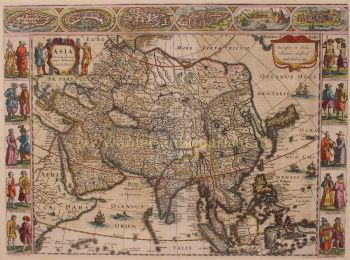
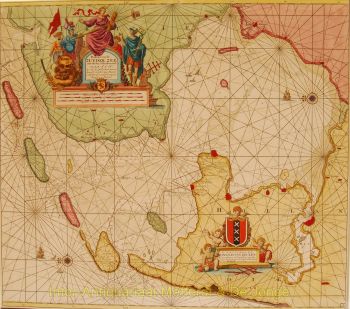
Southeast Asia - Hondius/Janssonius, 1647 by Johannes Janssonius
Scroll to zoom, click for slideshow

Southeast Asia - Hondius/Janssonius, 1647 1647

Johannes Janssonius

Paper
39 ⨯ 49 cm
€ 1.950

Inter-Antiquariaat Mefferdt & De Jonge

  • About the artwork
    Indiae que Orientalis dicitur, et Insulae Adiacentes, copper engraving first published by Henricus Hondius/Johannses Janssonius [Jansson] in 1636, here from the Atlas Novus edition of 1647. With original hand colouring. Verso: Latin text. Size: 39,8 x 49,2 cm. Henricus Hondius' 1636 map of Southeast Asia was based on Willem Blaeu's map from the previous year. Both maps were vast improvements from earlier maps of the region, and present the extent of the trading influence of the Dutch East India Company. This map features a dedication in Latin to the wealthy Dutch merchant Christoffel Thijs (1603-1680). The map includes Southeast Asia in general with all of Malaysia, the East Indies, the Philippines, Indonesia, Indochina and southern China with the Pearl River Delta, Taiwan, and part of Japan. Unfinished coastlines east and south of Java suggest the unknown lands still to be encountered by Europeans. Here, New Guinea is a long thin island with an open western edge. It is very close to another coastline that we now know is the York Peninsula in Australia. Although De Torres had sailed through the strait now named for him in 1606, the Spanish government suppressed news of the voyage. As a result, mapmakers for over a century would link Australia and New Guinea. Hondius, however, does not quite connect the two here, preferring a cautious approach to the still-mysterious area. There is a note that says that part of the island, known as “Terra d’os Papous” [Land of the Papuans] was named by Jacob le Maire. Le Maire was part of an important voyage from 1615 to 1617. Not only did he and his fellow Willem Schouten (whose name is on an island off the coast of the Terra d’os Papous) circumnavigate the world and name many Pacific islands with Dutch names, they also passed round Cape Horn via a strait that now bears Le Maire’s name. Reference: Koeman's Atlantes Neerlandici, Me 59 Price: Euro 1.950,-
  • About the artist

    Janssonius was born in Arnhem as the son of Jan Jansz, a printer and publisher there. At a young age he moved to Amsterdam, the then center of the printing and card trade. In 1612 he married Elisabeth Hondius, daughter of Jodocus Hondius. Elisabeth died in 1627 and Janssonius remarried in 1629 with Elisabeth Carlier. He went to work for his father-in-law and continued the publishing business together with Henricus Hondius (son of) after his death. This was developed into one of the largest of its time. There were branches in Berlin, Frankfurt, Geneva, Lyon and Stockholm, among others.

    Under Janssonius' leadership, the Mercator-Hondius Atlas was expanded and published as Atlas Novus. This initially one-volume edition soon became a multi-volume atlas, supplemented on request with nautical charts and/or celestial charts. There were publications in Dutch, French, Spanish and Latin. Like his contemporaries, Janssonius also made use of existing copper plates, including those from the city books of Braun & Hogenberg and the Description de touts les Pays Bas (Description of all the Netherlands) by Lodovico Guicciardini - (Cornelis Claesz. edition) from 1609 Although Janssonius has often been accused of copying Willem Blaeu's work, it may be noted that maps by Janssonius also appeared on the market earlier.

    After Janssonius' death, the firm was continued by his son-in-law, Johannes (Jan) van Waesbergen, who was married to his daughter Elisabeth Janssonius (1615-1681). Many copper plates of the city books were used (sometimes slightly modified) by Frederik de Wit. The building on Dam Square was leased to Gerard Valck; He also bought a number of printing plates in 1694.

Are you interested in buying this artwork?

Artwork details

Category
Subject
Style
Material & Technique