Two turtle doves on a branch by Aert Schouman
Scroll to zoom, click for slideshow

Two turtle doves on a branch 1750

Aert Schouman

PaperPencil
36 ⨯ 25 cm
€ 6.500

Inter-Antiquariaat Mefferdt & De Jonge

  • About the artwork
    Two turtle doves on a branch. Drawing in watercolour and bodycolour by Aert Schouman, executed around 1750. On the verso, annotated in Schouman’s own hand: “het bovenste een tortelduyf, dank het wijfie van onse inlandts. en de onderste een kaaps tortelduyfje bijde levendig” [“The upper one is a turtle dove, namely the female of our native (Dutch) species; and the lower one a Cape turtle dove, both rendered in a life-like manner.]. With watermark of the Strasbourg Lily. Size: 36.4 × 25.5 cm. Aert Schouman (1710–1792) was an artist of remarkably wide range, but his international reputation rests chiefly on his painted—and especially his watercoloured—bird studies, through which he secured a singular and exceptional position within art history. As far as is known, Schouman began making this type of bird portrait, such as the present doves, as early as 1734. He made them not only for collectors of drawings, but also for scholars and owners of cabinets of naturalia, who greatly valued his scrupulous and highly naturalistic treatment of proportions, contours, postures and colours. Schouman usually chose a very low viewpoint, creating a broad expanse of sky with subtly painted clouds. This gives the impression that the viewer is looking upward—an entirely natural perspective when observing birds. Over the course of the eighteenth century, interest in nature grew among an ever-widening public, including in the Netherlands. This curiosity extended to the exotic flora and fauna of overseas trading regions, from which interested professors, physicians, clergymen, merchants and government officials assembled natural specimens. As a result, numerous private cabinets of naturalia came into being. Schouman’s watercolours were acquired by such collectors not only as autonomous works of art, but also—indeed above all—as study material for their own collections. In this drawing we see a Dutch turtle dove (Streptopelia turtur), together with “a Cape turtle dove”. By this, Schouman is likely to have meant a pigeon (perhaps Treron calvus) ‘from Africa’, rather than specifically from the Dutch Cape Colony. This is a comparative study that cannot have taken place in nature. Exotic birds from Africa and Asia reached the Dutch Republic through the trading networks of the Dutch East India Company (VOC), with the Cape of Good Hope serving as an important hub. Within this context, such animals were kept, studied and depicted as objects of scientific curiosity and collecting culture, with geographically disparate species deliberately brought together in order to make differences in form, colour and origin visible. It is estimated that Schouman produced around 1,000 bird watercolours, depicting more than 240 different species. Writing about Schouman in 1842, J. Immerzeel observed: “The field in which Schouman particularly distinguished himself was that of birds. His birds are irreproachable in drawing, graceful and distinctive in posture and movement, downy, velvety, elegant or richly variegated in plumage. To this he united an ease of execution that testified to the certainty with which he handled both brush and pen. Nor was there any lack of connoisseurs who knew how to appreciate his work, and collectors gladly opened their portfolios to his finely worked bird drawings, executed with watercolour.” Price: Euro 6.500,- (incl. frame)    
  • About the artist

    Aart Schouman (also spelled Aert Schouman) (Dordrecht, March 4, 1710 – The Hague, July 5, 1792) was a versatile Dutch painter and wallpaper painter, etcher, watercolorist, and engraver. Although his work enjoyed relatively little recognition for a long time, he was a leading artist in Zeeland and the south of Holland in the eighteenth century, with a career that spanned Dordrecht, The Hague, and Middelburg.

    At fifteen, Schouman apprenticed with painter Adriaan van der Burg. In 1736, he founded the Dordrecht Brotherhood of Saint Luke, an association for art lovers and amateurs in the region. He also played a prominent role in The Hague: he chaired the painters' brotherhood Pictura for four years and was also an honorary member of a Hague poetry society.

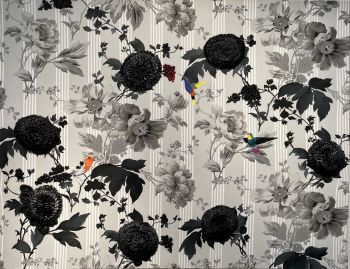
    His oeuvre consists of portraits and large, painted wallpapers. Initially, he worked primarily with mythological and biblical themes, but later his focus shifted to more decorative and natural history subjects: compositions with birds, rare animals, and plant studies. He drew animals from the menagerie of stadtholder William V at Het Kleine Loo and was especially appreciated for his watercolors of cityscapes and park-like landscapes with exotic birds—remarkably unique at the time and still recognizable as his signature. Besides painting, he engaged in etching and glass engraving, and he also collected art himself. His life is exceptionally well documented, thanks to his diaries.

    In recent years, his work has been visibly revalued. The Dordrechts Museum organized several exhibitions dedicated to Schouman, and in 2020, two wallpapers he painted in Paris were purchased for Huis ten Bosch Palace, where they were displayed in the black dining room. His works were again shown at the Dordrechts Museum in 2025–2026, further strengthening his reputation as a refined depiction of nature and decoration.

Are you interested in buying this artwork?

Artwork details