Jules Chapon, born in Heemstede in 1914 – died in Saint-Cyprien, Dordogne in 2007, was a Dutch sculptor, stained glass artist and painter.
Childhood and background
Jules was born as the son of Barend Chapon and Mietje Zilverberg. His father was a stockbroker, chairman of the church council of the Jewish community in Haarlem and a member of the Jewish Council. Chapon grew up in an artistic environment. His father owned an art collection from the Hague, Amsterdam and Bergen Schools and was interested in architecture. His sister was a dancer. Around the age of ten, Jules received his first painting kit. Although he initially seemed destined for a career in finance, he definitively chose to become an artist during the war.
War years and loss of family
During the mobilization, Chapon was stationed as a soldier in Rotterdam, where he experienced the bombing. In 1941, his father's investment company was confiscated and liquidated by the Germans. Jules then started painting and drawing again.
In 1942, he joined the resistance. Among other things, he helped Jews obtain false identity papers. In September 1943, he was betrayed and arrested. Jules was interrogated and abused in Amsterdam. During a moment of inattention, he managed to escape via the bicycle shed of the police station. He then went into hiding at various addresses and began reading philosophy intensively. This period gave him peace and reflection.
He concluded that material life was empty. If he were to survive the war, he wanted to occupy himself with something substantial. In the meantime, a tragedy unfolded in his family. Early in 1943, his father was arrested and on 2 February, together with Chief Rabbi Philip Frank, he was shot in the dunes near Bloemendaal. On the same day, his mother and sister were also arrested; his other sister, Selma, was not at home and survived the war. Jules and his brother initially managed to escape, but his brother returned to not leave the women alone and was arrested anyway. They were all deported to Auschwitz via the Hollandse Schouwburg and Westerbork and murdered.
Restart in Haarlem and confrontation with the past
After the war, Chapon returned to Haarlem, where he single-handedly restored an old building on the Klein Heiligland. He also used it as a gallery. Jan Nederkoorn, the man who had betrayed his family, lived nearby. Every encounter with him was a confrontation. Jules tried to run him over twice with his car. His family doctor then advised him to leave the Netherlands. He now owned a ruin in the Dordogne and decided to settle there permanently.
Early artistry and style development
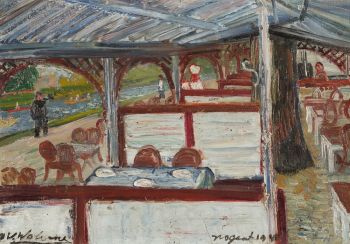
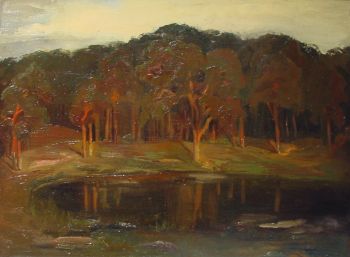
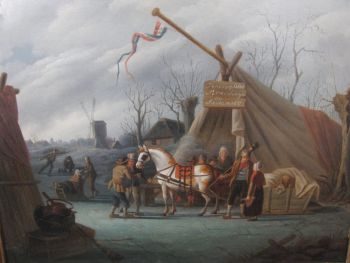
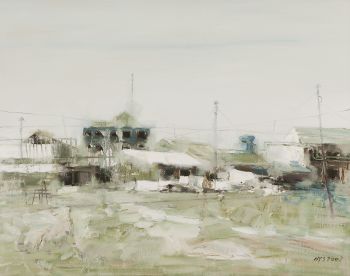
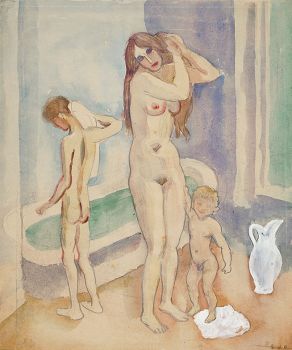
In the first years after the war, Jules worked in a naturalistic style. He processed his war experiences in gloomy, charged paintings such as Hunger Winter and Concentration Camp I and II. He took lessons from Henri Boot and Kees Verwey. In 1940 he married Polly Meure.
Breakthrough and influences from the South of France
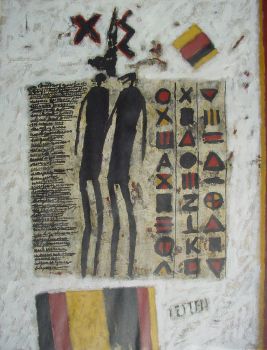
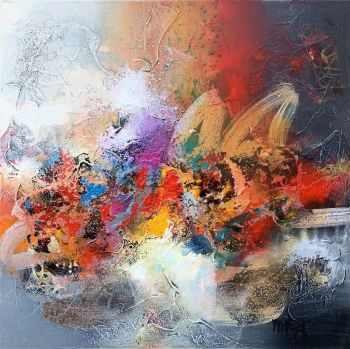
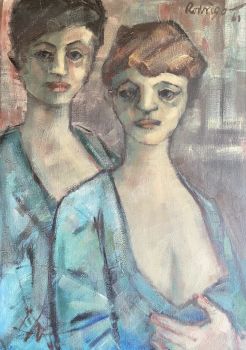
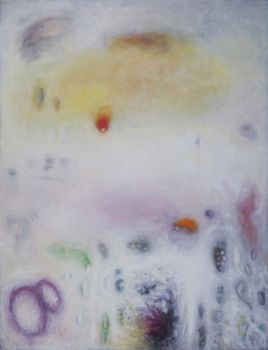
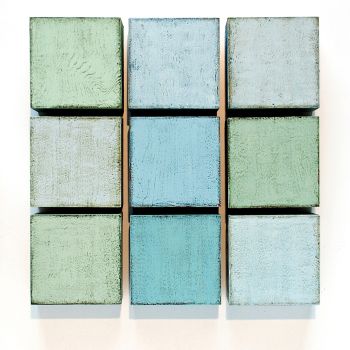
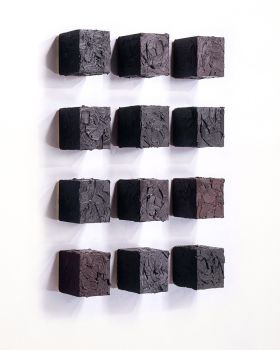
From 1947 Chapon exhibited his work in the Netherlands and France. He painted landscapes, portraits, still lifes and figure representations. His style began to change through encounters with artists and poets such as Nicolas de Staël and René Char in the South of France. Under the influence of Danish Cobra artists he started to work more expressively and abstractly. His use of colour became more lively, his lines simpler. From 1957 he made exclusively abstract work.
Galerie Espace and artists' network
In 1956 Jules, Polly Meure and Eva Bendien founded Galerie Espace, in the studio of Jacob Bendien on the Klein Heiligland in Haarlem. In 1960 the gallery moved to Amsterdam. The gallery still exists. Chapon was also active in the Haarlem artists' association Teisterbant, together with, among others, Godfried Bomans, Anton Heyboer and Harry Mulisch.
End of his marriage
In the sixties Jules and Polly grew apart. In 1964 she left for Belgium, where she started a gallery in Brussels. The divorce followed a few years later.
Monumental commissions and international recognition
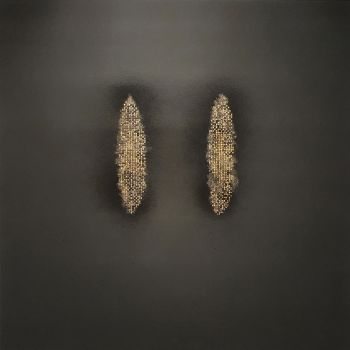
Between 1960 and 1980 Chapon received important monumental commissions. He produced impressive walls for, among others, the Fokker factories at Schiphol, De Nederlandsche Bank in Amsterdam and the Bijlmerbajes. He used old ship plates in which holes were burned, filled with glass appliqués in collaboration with the Van Tetterode studio. In 1968 the three-year production process of the wall for De Nederlandsche Bank was recorded by filmmaker Wim van der Velde. The film won a gold medal at a festival in Bilbao in 1972.
Back to painting in France
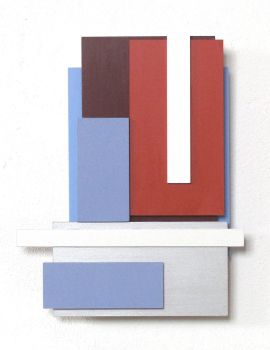
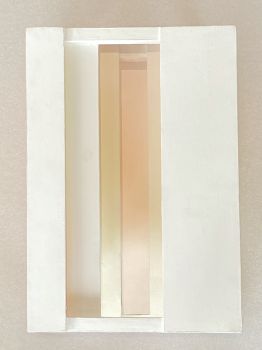
From the seventies Chapon also experimented with polyether and plexiglass. In 1973 he settled permanently in the Dordogne. The tranquility of the French countryside gave him space to fully develop again to focus on painting and drawing. He felt at home there, unlike the Netherlands, which reminded him too much of misery and loss.
Recognition and reflection in later years
In 1996, a retrospective of his work was held in the Jewish Historical Museum. In the same year, Chapon told his life story to the USC Shoah Foundation Institute, founded by Steven Spielberg. This was included in the collection 2000 Witnesses Tell of the Jewish Historical Museum.
Philosophy, simplicity and the artist
In his later years, Chapon increasingly returned to the essence. He strove for simplicity, silence and concentration in his work. He believed that art should not display misery, but should offer the viewer space to form their own thoughts. Jules considered painting and drawing as a form of existence — one that he could no longer do without. His gaze on the landscape gave him a sense of infinity in which he wanted to discover the lines again and again.
In the 1950s, art critic Hans Redeker described him as “a contemplative, closed and introverted figure.” He himself later admitted: “My liberation actually only came when I moved to France for good.”