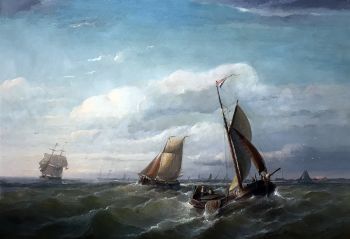
Jan Voerman Sr. was born on 30 January 1857 in Kampen, a Hanseatic city on the IJssel where water, clouds and light perform their own theatre every day. It is therefore no coincidence that Voerman found his lifelong muse here: the river, the sky above it, and the changing interplay between them. As a painter of the IJssel, he became a master in capturing the elusive – steam, silence, menace, vastness – and gave it a permanent place in Dutch painting.
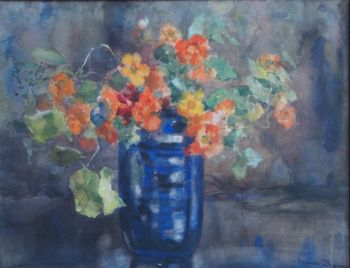
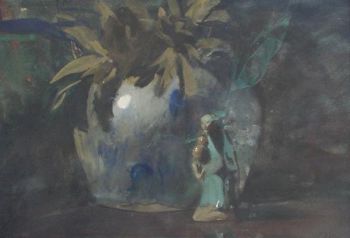
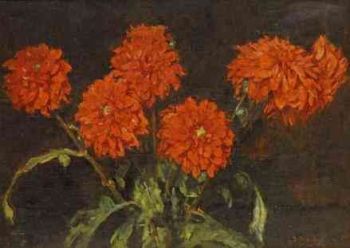
His education began at the Rijksacademie van Beeldende Kunsten in Amsterdam, where, under the influence of August Allebé and others, he initially painted mainly floral still lifes and genre pieces. However, he soon returned to his native soil, where he found his true voice. Around 1890 he settled in Hattem, on the other side of the river, in a house with a view of the floodplains of the IJssel. This became his lifelong studio.
What makes Voerman unique is his ability to evoke a maximum of atmosphere with a minimum of means. His use of colour is often cool, his compositions open and breathtakingly quiet. Cloudy skies sometimes take up more than two-thirds of the canvas; the land beneath them seems only a footnote to the grandeur of nature. And yet everything is in balance: the horizon does not sink, the air does not press down – it breathes.
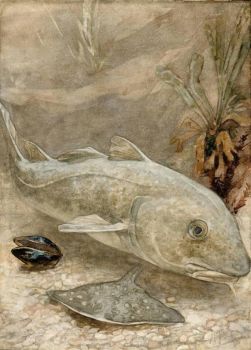
In addition to his free work, Voerman achieved great fame as an illustrator for the famous Verkade albums, an initiative by Jac. P. Thijsse that brought nature experiences to a wide audience. Voerman's careful, dreamy illustrations gave flora and fauna an almost fairytale glow, without ever becoming unnatural. With this he reached generations of children and adults – and added colour to the Dutch imagination of nature.
Although he rarely mixed in the art world of his time, his work was certainly noticed. Art critics praised his unique style, and colleagues admired his ability to make light and space almost tangible. He was not an innovator in the modernist sense of the word, but rather a refiner – someone who continued to work on a motif until it took on its definitive form.
Jan Voerman Sr. died in 1941, in Hattem, where he had captured the world above the IJssel for more than fifty years. His legacy is not a grand oeuvre in volume, but in intensity. His paintings are windows to a Netherlands that still knew roughness and tranquility, and in which the sky always had something to say.
In the Voerman Museum Hattem his work lives on – together with that of his son Jan Jr. – as a tribute to a painter who not only looked, but really saw.