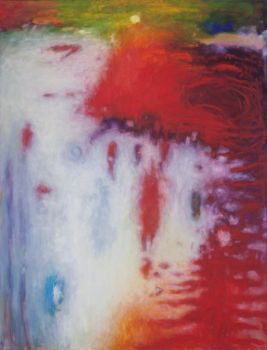
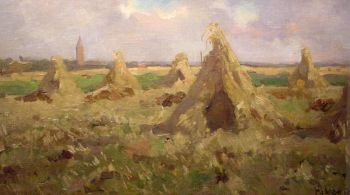
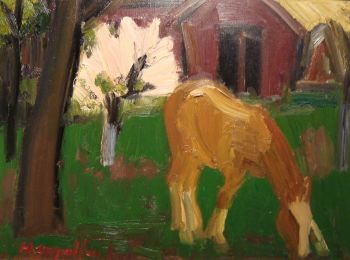
Dirk Hidde Nijland was born on 15 March 1881 in Utrecht. He grew into a versatile and powerful artist with a distinct, expressionist style. His oeuvre includes landscapes, figure pieces, still lifes and religious scenes, in which colour, form and faith enter into dialogue with each other. Nijland was a painter who did not seek beauty in convention, but truth in expression.
He studied at the Rijksakademie van Beeldende Kunsten in Amsterdam and came into contact with traditional painting there, but soon found his own way. In the early years of his career he joined the artistic innovations of his time. Although he did not become a member of the great avant-garde movements such as De Stijl, he felt a strong affinity with German and Dutch expressionism.
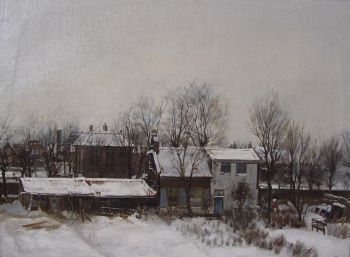
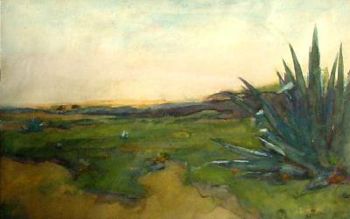
His work is powerful in structure, with angular shapes, bright colours and a strong, often black contour. In contrast to the subtle impressionists of his time, Nijland opted for the direct gesture, the simplified form, and psychological depth. He painted village scenes, interiors, working people, animals and biblical scenes — always with a palpable inner conviction.
Nijland was deeply religious, and his faith permeates his work in a sober but powerful way. He saw art as a means of giving meaning and contemplation, not as a mere aesthetic game. His religious works — such as Christ in the Garden of Gethsemane or Supper at Emmaus — convey a spiritual seriousness that is rare in modern Dutch painting.
In addition to being a painter, he was also a teacher and writer. He had a keen eye for the development of young artists and spoke out about the role of art in a secular society. Although his work remained on the fringes of the official art world, it was recognized by his peers for its authenticity, power and spiritual charge.
Dirk Hidde Nijland died on 26 August 1955 in his birthplace Utrecht. His work is included in collections of the Centraal Museum Utrecht and Museum De Fundatie, among others.
He remains an idiosyncratic figure in Dutch art history — a painter who turned away from fads and became timeless precisely because of it. His art is uncompromising, sensitive and fierce: a visual testimony to a deeply lived life.